Who Owns AI-Generated Music? Copyright, Licensing & Distribution Checklist
Sort out copyright ownership of AI-generated music in 2026, covering copyright, commercial licensing, source audio rights, platform policies, and distribution filing
Quick Answer: Copyright Ownership Is a Layered System, Not a Black-and-White Verdict
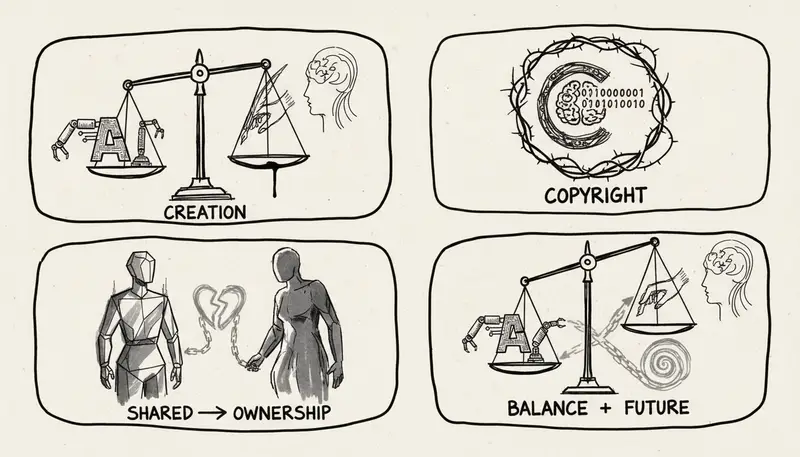
If you use an AI music generation tool to create a track, the actual copyright ownership depends on multiple layers:
- Platform License Agreement — what the tool's terms allow you to do with the generated output.
- Copyrightability — whether the final work contains enough human creative input to qualify for copyright protection in your jurisdiction.
- Source Material Copyright — whether any audio, vocals, lyrics, melody, stems, samples, or reference material you uploaded belongs to you or is legally usable.
- Distribution Platform Policies — specific requirements from platforms like Spotify, YouTube, TikTok, Apple Music, stock libraries, or client marketplaces.
- Creation Records — whether you can provide proof of prompts, editing history, dates, subscription plan status, source files, and human creative decisions.
This is why "Do I own AI-generated music?" is not the primary question. A better question is: What rights do I have? What creative contributions did I make? Can I document the entire creation process?
This guide provides general information only and does not constitute legal advice. If you are preparing a high-value release, promotional campaign, music licensing placement, client contract, or handling a copyright dispute, please consult a qualified attorney.
What Current Copyright Guidelines Actually Say
The most reliable public reference source is the U.S. Copyright Office. Its 2023 registration guidance for works containing AI-generated content requires evaluation of human creative input; its 2025 report on copyrightability clarifies that purely AI-generated content is not protected under U.S. copyright law, but human-authored expression, creative choices, arrangement, or modification may still receive copyright protection.
Useful official references:
- U.S. Copyright Office Registration Guidance for Works Containing AI-Generated Content
- U.S. Copyright Office "Copyright and Artificial Intelligence Part 2: Copyrightability Report"
For creators, the practical takeaway is simple:
| Creation Scenario | Actual Copyright Risk |
|---|---|
| One-click generation with a short generic prompt | Weaker copyright claim on the AI-generated content itself |
| Detailed prompt with selection from multiple results | Better demonstrates your creative direction, but prompt-only claims may still be limited |
| Writing your own lyrics, arranging, editing, mixing, or recording new parts | Stronger copyright claim on the human-created portions |
| Uploading someone else's vocals, songs, or stem files | Separate ownership issues exist even if the AI-generated output sounds completely new |
| Using a platform subscription plan with commercial rights | Valid contractual usage rights, but this is not the same as owning the copyright |
AI Itself Does Not Own Song Copyright
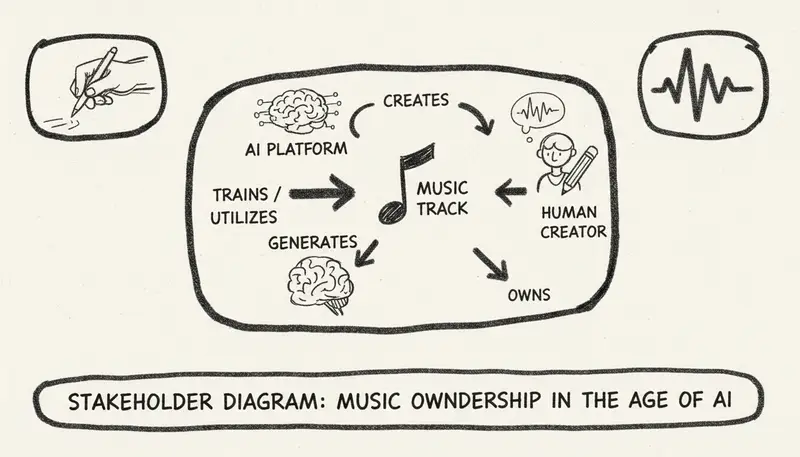
AI systems are creative tools, not legally recognized authors. The harder question is: does the human user or the platform terms of service determine the rights you need for your intended use?
In practice:
- AI models themselves do not hold copyright.
- Platforms may grant you rights to generated works through their terms of service.
- You can own and control the human-created content you contributed.
- Copyright ownership of AI-generated content may be uncertain.
- Generative systems are typically non-exclusive, so similar works may be generated.
This is why a quality production workflow matters. The more your final work reflects your own lyrics, arrangement ideas, editing adjustments, vocal recordings, instrumental parts, mixing choices, and documented creative direction, the stronger your practical rights protection.
Commercial License Does Not Equal Copyright Ownership
Many AI music tools advertise commercial permissions, paid licenses, or creator rights. These are important, but they do not necessarily mean "you permanently own full copyright to all elements."
Before publishing or selling, confirm the following:
| Question | Why It Matters |
|---|---|
| Does my plan allow commercial use? | Monetization, client work, ad placements, and content distribution may depend on this permission. |
| Are generated works exclusive? | Other users may generate similar works. |
| Can I distribute works to streaming platforms? | Some tools allow use of generated content but restrict standalone resale. |
| Can I use my uploaded source audio? | You still need legal rights to all input materials. |
| Can I use someone else's voice, likeness, or artist reference material? | Voice cloning and impersonation may trigger additional legal or platform compliance issues. |
| What proof should I retain? | Clients, distributors, and dispute resolution typically require documentation. |
For MusicMake.ai, be sure to check the latest Pricing, Terms of Service, and Changelog. Product features and plan contents change over time, and old blog posts may become outdated after tool updates.
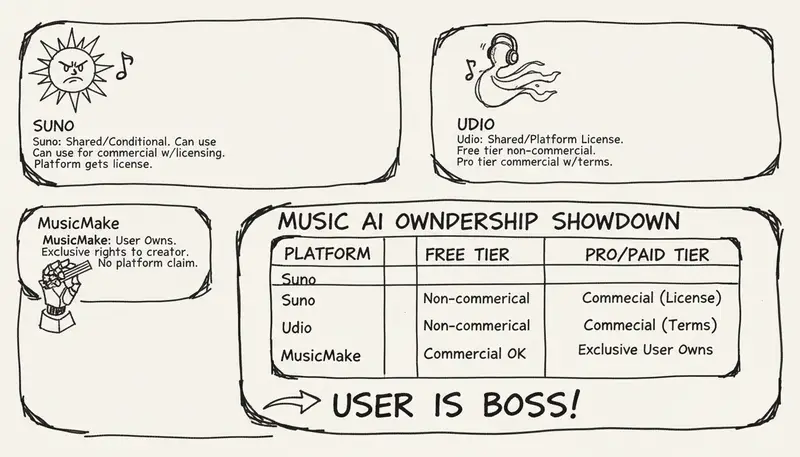
Our current public MusicMake.ai terms, verified on June 14, 2026, show: between you and MusicMake.ai, to the extent permitted by law and subject to third-party input material rights, plan-specific license limitations, and terms compliance requirements, you own the music and other output content you generate. The terms also clarify that generated content is not guaranteed to be unique, may not be copyrightable, does not exempt third-party claims, and platform-issued certificates are product records only — not government registrations or legal advice.
Pre-Publication Copyright Ownership Assessment
Before publishing, classify your work into one of the following categories. The goal is not a perfect legal conclusion, but to identify obvious publication risks before money, clients, or distribution are involved.
| Work Status | Publication Decision |
|---|---|
| Generated with a free plan that does not allow commercial use | Treat as a demo draft; recreate or complete a commercial version using a plan that allows commercial use. |
| Generated with a paid plan that includes commercial permissions | Retain plan order proof, generation date, output files, and currently valid terms before publishing. |
| Made with your own lyrics, arrangement ideas, editing, or recordings | Retain human-created files, as these are easier to demonstrate ownership over than purely AI-generated audio. |
| Made with uploaded audio, vocals, stems, samples, or reference material | Confirm source material licensing compliance before publishing — AI tools cannot license input material you don't have rights to. |
| Custom production for a client | Align platform license terms with client contracts and clearly define the scope of rights delivered. |
| Generated with a competing tool such as Suno, Meloflow, Udio, or AIVA | Check current plan pages and terms for commercial use permissions, source material rules, attribution requirements, resale limitations, and whether rights survive subscription cancellation. |
Suno is a case study in why timeliness matters. Its public pricing and help pages, verified on June 14, 2026, and refreshed in Chrome on June 15, show: its free plan does not allow commercial use, and by default, subsequent paid subscriptions do not retroactively grant commercial rights to works generated during the free plan period. This type of rule illustrates why copyright ownership should be assessed per-work, not based on a platform's general marketing claims.
MusicMake.ai Copyright Ownership by Scenario
| MusicMake.ai Usage Scenario | Practical Copyright Ownership Conclusion |
|---|---|
| You generated an original track from a clean text prompt | Check current active plan and terms, then save generation records, exported files, and available copyright certificates. |
| You used your own lyrics or arrangement modifications | Save these human-created files separately, as they serve as stronger creation evidence than AI-generated audio. |
| You uploaded songs, vocals, stems, melodies, or reference material | Ownership of the material first depends on whether the input belongs to you or was authorized; AI-generated content does not resolve input material copyright issues for you. |
| You used Music Agent to incorporate feedback | Save assistant notes or approval card details as part of your creation process record, but do not treat them as legal guarantees. |
| You need to deliver work to a client | Before delivery, confirm compliance with MusicMake.ai plan requirements, export format, certificates/records, source material authorization proof, and client contract terms. |
| You need a strong copyright claim | Focus on human-created portions — lyrics, modifications, arrangement, recording, selection, or meaningful adaptation. |
How MusicMake.ai Helps Reduce Copyright and Workflow Disputes
MusicMake.ai is no longer just a simple AI music generation tool. Our product direction is Music Agent first: building a music chat-based creation workflow where users don't need to be prompt experts to describe song requirements, review generated results, adjust creative direction, and seamlessly switch between generation and editing tools.
This is critical for copyright ownership and release readiness, because a more complete workflow record provides stronger evidence.
MusicMake.ai's practical tools include:
- Generate: for original AI music creation.
- AI Lyrics Generator: for drafting or refining lyric ideas.
- AI Music Style Generator: for generating clearer genre and arrangement descriptions.
- Cover: for reinterpreting vocals or genre when you have legal source material authorization.
- Extend: for extending arrangement length.
- Add Tracks, Mashup, and Replace Section: for editing and restructuring parts of a track.
- Vocal Remover: for stem production workflows when source audio is authorized.
- Music Agent as the core music chat assistant, song creation assistant, and GPT-like music assistant — helping with prompt rewriting, tool selection, and iterative modifications.
The core differentiator is not "chatting with AI" but helping creators transform vague feedback (like "the beat is wrong" or "keep only the guitar") into more structured generation instructions and clearer editing decisions.
A Practical Copyright-Aware Creation Workflow
Before publishing an AI-assisted song, follow this process.
Step 1: Start with Legally Compliant Input Material
Do not upload vocals, songs, stems, loops, or samples unless you own them, created them yourself, or have written authorization or license to use them.
This includes:
- Cover vocals
- Reference tracks
- Acapellas
- Instrumental stems
- Sample packs
- Client materials
- Band recordings
- Public domain or Creative Commons works with usage restrictions
Step 2: Write or Edit Human-Created Elements
When you create or substantially edit parts of the work, your human creative contribution becomes easier to demonstrate:
- Original lyrics
- Section structure
- Chord progressions
- Melody notes or motifs
- Arrangement notes
- Instrument selection
- Final version selected from drafts
- DAW editing, mixing, and mastering
- Additional recorded vocals or instruments
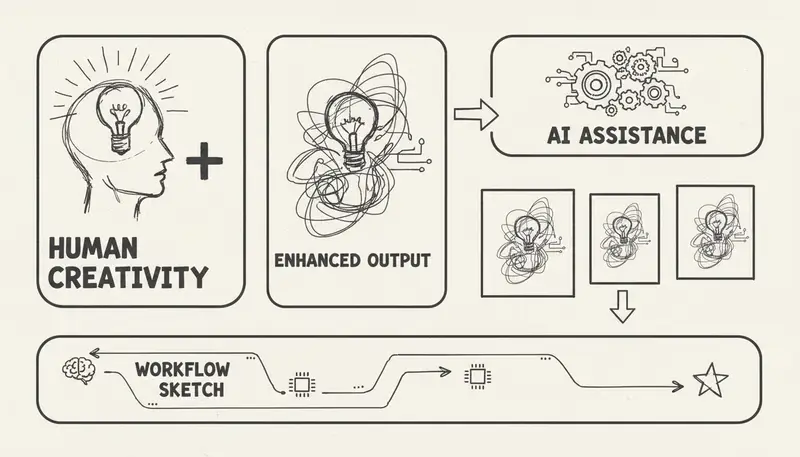
Step 3: Use Music Agent to Clarify Creative Intent
Instead of repeatedly submitting the same underperforming prompt, use the Music Agent workflow to collect feedback and refine creative constraints.
Examples:
- "Keep the drums, keep only the fingerpicked acoustic guitar solo."
- "Remove the rhythm section, keep the melody free-flowing."
- "Make the vocals more intimate, less dramatic."
- "Extend the chorus but keep the original tempo and mood."
- "Replace the bridge with a simpler section."
This approach leaves a clearer creative trail than a single generic prompt.
Step 4: Save Distribution Proof Files
Create a separate folder for each track containing:
- Prompt history
- Music Agent feedback or modification notes
- Generation content URL or filename
- Generation date
- Plan or invoice records
- Source material authorization licenses
- Hand-written lyrics
- DAW project files
- Exported final master
- Distribution metadata
Documentation doesn't automatically grant copyright, but it helps explain your specific situation.
Practical Scenarios
Can I upload AI music to streaming platforms?
Generally, the answer depends on your platform license agreement, distributor rules, and whether the track uses authorized source material. Some distributors and platforms may require additional information, such as AI generation involvement, voice cloning usage, samples, or copyright status.
Before uploading:
- Confirm your AI tool plan allows commercial distribution.
- Ensure source audio is legally authorized.
- Don't impersonate real artists or use protected names in metadata.
- Retain your generation and editing records.
- Comply with the platform's current disclosure requirements for AI or synthetic media.
Can I register copyright for an AI-assisted song?
Yes, but the copyright claim must focus on human-created portions. According to U.S. copyright guidelines, purely AI-generated content cannot be classified as protected human original work. Hand-written lyrics, arrangement, editing, recording, and creative choices are more likely to meet copyright protection requirements.
Can someone else generate a similar song?
Yes, this can happen. Unless platform terms explicitly guarantee it, AI-generated music is typically not guaranteed to be unique. Similar prompts, similar models, or generic genre conventions may produce similar results.
Can I use AI music for client projects?
You need to ensure three things align:
- Platform license agreement
- Client contract
- Your source material copyright
For formal client projects, contracts should clearly state AI-assisted creation, source material usage, commercial licensing, and deliverable content terms.
Pre-Distribution Copyright Checklist
Before commercializing or distributing a track, use this checklist:
| Check Item | Passing Standard |
|---|---|
| Platform Plan | Your current plan supports planned commercial use within the plan scope |
| Material Copyright | All uploaded source files belong to the uploader, are authorized, or have legal usage licenses |
| Voice & Likeness | No unauthorized real-person voices, artist names, or voice imitation content used |
| Human Creative Contribution | Lyrics, arrangement, editing, recording, or track selection have documented records |
| Compliance Disclosure | You have complied with the target platform's requirements for synthetic media or AI-generated content |
| Metadata | Song title, artist name, credits, and description do not mislead listeners |
| Operation Records | Prompt records, Music Agent notes, files, dates, and receipts are properly saved |
Related Reading
- AI Music Copyright Law Guide 2026: Practical Handbook for Creators and Teams
- AI Music Copyright Guide 2026: Ownership, Commercial Use & Filing Essentials
FAQ
Do I own music I created with AI?
Based on platform terms, you may have commercial usage rights, and the human-created content you added belongs to you. Copyright ownership of AI-generated portions remains unclear and depends on your jurisdiction's rules and your actual creation process.
Is all AI-generated music in the public domain?
No. The fact that purely AI-generated content is not copyrightable does not mean all platform-generated works can be freely used by anyone. Contractual terms, source material copyright, and platform rules still apply.
Do I need to credit the AI platform?
Check platform terms and the requirements of the upload scenario. Even if the law doesn't mandate attribution, distributors, clients, video platforms, or local regulations may require you to disclose AI-generated content.
Can a prompt alone prove copyright ownership?
Prompt operations help document creative direction, but the U.S. Copyright Office currently takes a cautious approach to whether a prompt alone constitutes sufficient human control over expressive output. More persuasive human authorship typically comes from lyric creation, editing, arrangement, track selection, recording, or meaningful content modification.
Does using Music Agent give my song stronger legal protection?
No tool can guarantee legal protection for a work. Music Agent's role is to optimize the creation workflow, make feedback clearer, reduce wasteful generation attempts, and help you better document the creation history of your final song.
Core Takeaway
The safest approach is not to vaguely claim "full ownership of AI music" but to treat each work as a bundle of copyright interests:
- Confirm your platform usage license
- Use only authorized materials
- Add human-created content and keep records
- Comply with target platform disclosure requirements
- Maintain complete and clear creation process documentation
If you use MusicMake.ai, Music Agent can help you transform vague music feedback into clearer prompts and editing instructions, while its complete tool set helps you go from inspiration to lyrics, style setting, music generation, cover creation, content extension, stem export, and final modification.
Music generated on MusicMake.ai carries no commercial risk — you can confidently use it for all types of commercial projects. Daily check-ins also earn free credits to get started easily.
著者

カテゴリー
もっと見る
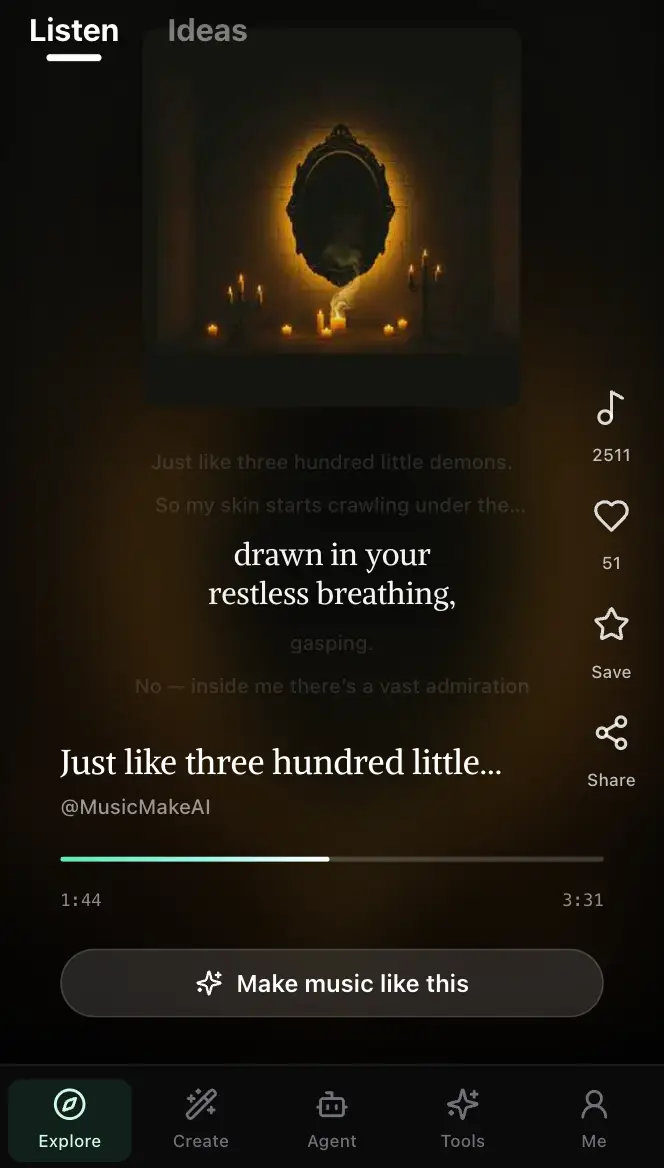
MusicMake.ai Mobile Update: Create Music From Your Phone Like an App
MusicMake.ai now gives creators a complete mobile flow for listening, generating, refining with Music Agent, opening tools, and managing songs from a phone.
AI Songwriting Guide: How to Write Songs with AI in 2026
Learn how to use AI songwriting tools to write better songs faster. Step-by-step guide covering lyrics, melody, arrangement, and production with AI assistance.
how to become a music producer with ai tools - MusicMake.ai Guide
Learn about how to become a music producer with ai tools with this comprehensive guide from MusicMake.ai.