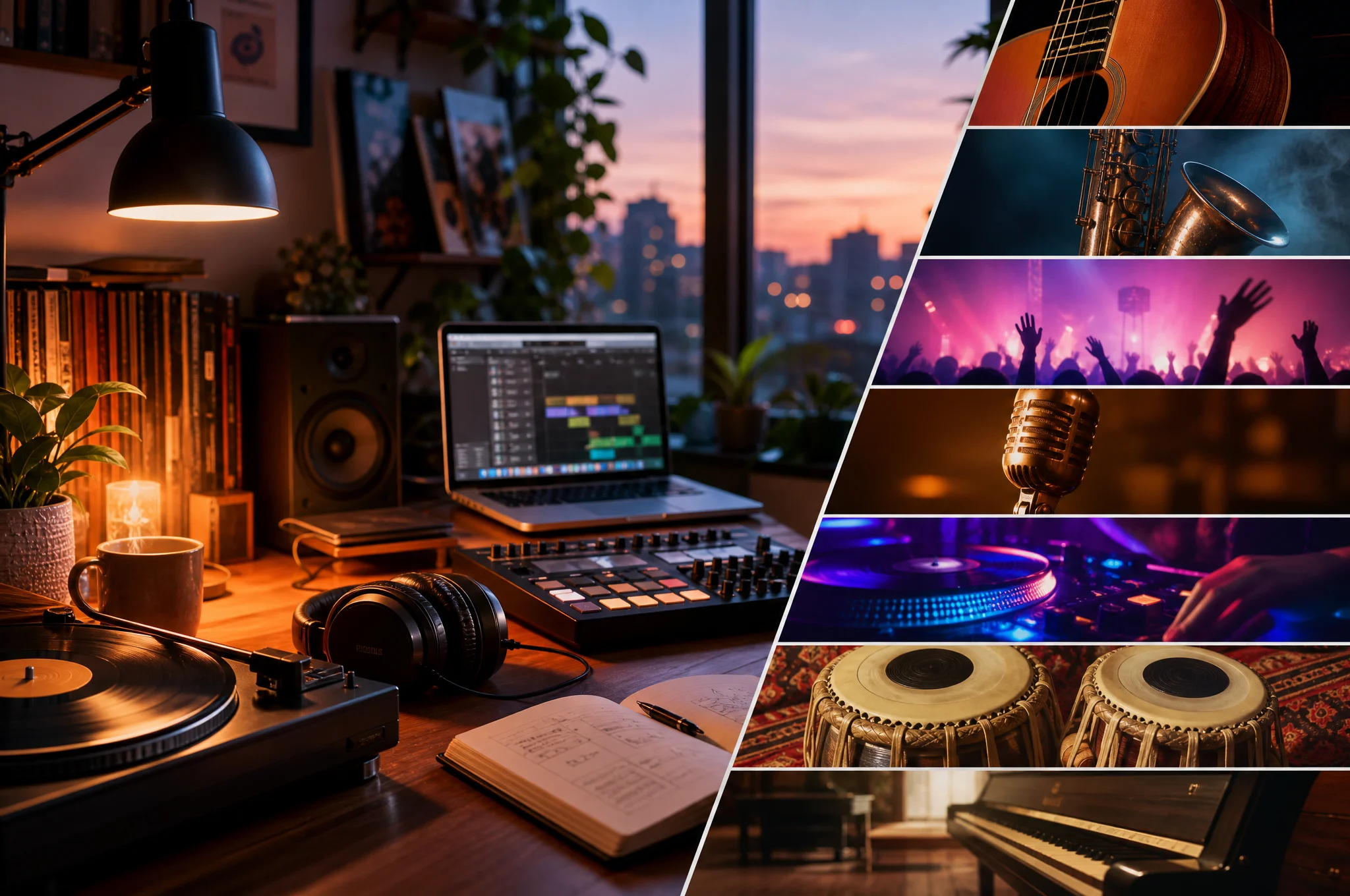
Study Music Style: A Complete Guide to AI Music Creation
Explore study music styles and subgenres, and master AI music creation techniques. Create professional-grade study music with MusicMake.ai.
What Is Study Music?
Study/Focus Music is a genre specifically designed to enhance concentration, memory, and learning efficiency. The primary goal of this music is not entertainment but creating an auditory environment conducive to deep thinking and effective studying.
The core principle of study music is "low distraction" — it needs to be pleasant enough to mask environmental noise, but not so engaging that it captures attention. Lo-Fi Hip-Hop, ambient music, and classical piano are among the most popular study music styles due to their simple, repetitive structures and gentle timbres. Research shows that appropriate study music can improve focus, reduce anxiety, and extend study duration.
In AI music creation, study music is a highly practical application. AI can generate continuous, low-distraction background music tailored to different study scenarios and duration needs, helping students, knowledge workers, and content creators obtain the ideal study soundtrack.
Whether you're a student, knowledge worker, or educational content creator, MusicMake.ai can help you quickly generate professional-grade study music assets. From Lo-Fi Hip-Hop to classical piano, from ambient music to minimalism, AI can precisely capture the low-distraction qualities of study music.
Core Characteristics
The design of study music follows a unique set of acoustic and psychological principles. Here are the key characteristics that define quality study music:
- Low Distraction: Music doesn't steal attention, existing as background
- Steady Rhythm: A stable beat helps maintain focus
- Simple Structure: Avoids complex structural changes and abrupt dynamic contrasts
- Gentle Timbres: Uses soft instrument tones, avoiding harsh or sharp sounds
- Repetition: Moderate repetition helps create a predictable auditory environment
- No Lyrics or Simple Lyrics: Lyrics interfere with language processing; pure instrumentation or simple vocal hums are preferable
- Sustainability: Suitable for extended playback without causing listener fatigue
- Spatial Quality: Moderate spatial depth and reverb create a comfortable listening atmosphere
- Narrow Dynamic Range: Minimal volume fluctuations, avoiding sudden loudness changes that trigger the startle reflex
- Frequency Balance: Primarily mid-to-low frequencies, reducing high-frequency stimulation and lowering auditory cortex load
- Emotional Neutrality: Doesn't provoke strong emotional swings, keeping cognitive resources focused on the learning task
History
The concept of study music traces back to the classical music era. Mozart's music, with its clear structure and pleasing melodies, has been widely believed to aid learning and thinking. In 1993, Rauscher et al. published research on the "Mozart Effect," sparking widespread discussion about the relationship between music and cognitive ability.
In the 2000s, with the rise of streaming platforms, playlists specifically designed for studying began to appear. Lo-Fi Hip-Hop, with its simple drum loops and warm sample textures, became the quintessential style of study music. The "Lo-Fi Hip Hop Radio - Beats to Relax/Study to" livestream on YouTube became a shared memory for learners worldwide.
Contemporary study music shows a trend toward high specialization. From focus enhancement to meditation and relaxation, from deep work to creative brainstorming, different cognitive tasks correspond to different music needs. The addition of AI technology has made it possible to customize music based on individual study habits and preferences.
In China, the demand for study music is also growing rapidly. With the proliferation of online education and the increasing number of knowledge workers, the demand for high-quality study music continues to rise.
From a neuroscience perspective, the mechanisms behind study music have been fairly well researched. Appropriate background music can promote dopamine secretion — a neurotransmitter closely associated with pleasure and motivation that helps learners maintain a positive study state. Meanwhile, music's rhythmic patterns can guide brainwaves into the Alpha wave state (8-13Hz), which is the ideal frequency range for a relaxed yet focused mind. Research from Cambridge University has found that music at 60-70 beats per minute is closest to the resting heart rate and can effectively reduce cortisol levels, thereby reducing study stress.
Additionally, music's utilization of the "cocktail party effect" is an important principle in study music design. The human brain is innately attuned to detecting sound changes in the environment, and continuous stable study music can "occupy" this attention channel,block more distracting environmental interference. This principle explains why white noise and pink noise are particularly effective in open-plan office environments — they provide uniform frequency coverage that eliminates the attention disruption caused by sudden sounds in the environment.
A 2021 meta-analysis published in Scientific Reports further confirmed that instrumental background music has the most significant effect on reading comprehension and memory retention, while music with lyrics may interfere with language-based learning tasks. This finding directly guides study music creation practice: prioritize pure instrumental arrangements, avoid vocal-dominant sections, and keep melodic lines simple and unobtrusive.
Study Music in the Digital Age
The digital age has brought unprecedented transformation to study music. The proliferation of streaming platforms has turned study music from a niche interest into a global cultural phenomenon. Focus playlists on Spotify have cumulatively exceeded billions of plays, and study music livestreams on YouTube run 24/7, providing real-time background music services to millions of learners worldwide.
The development of smart devices has also given rise to new study music consumption scenarios. From noise-canceling headphones to smart speakers, from focus apps to online learning platforms, study music has become deeply embedded in the digital learning ecosystem. Many learning apps have begun integrating AI music generation features that adjust music parameters in real time based on the user's focus state — when a drop in attention is detected, the music may subtly adjust its rhythm or timbre to help the user re-enter a focused state.
The maturation of AI technology is reshaping how study music is created. Traditionally, producing a piece of high-quality study music required professional musicians to spend hours arranging and recording. Today, AI music generation tools can produce professional-grade study music in minutes and support fine-grained customization based on personal preferences and study scenarios. This not only lowers the barrier to study music creation but also provides educational content creators with an endless supply of personalized soundtrack resources.
Personalized recommendation algorithms are also changing how people discover study music. Based on users' listening history, study time patterns, and focus data, platforms can intelligently recommend study music that best matches their current state. From one-size-fits-all universal playlists to personalized study soundtracks tailored to each individual, digital technology is making study music more precise and efficient.
Meanwhile, the rise of study music communities is noteworthy. Large communities of study music enthusiasts have emerged on Reddit, Discord, and various social platforms, where users share their study music playlists, discuss the effectiveness of different styles, and even collaboratively create open-source study music projects. This community-driven content ecosystem provides rich sources of inspiration and user feedback for AI music creation.
Creating Study Music with MusicMake.ai
Using AI Music Generator
Visit the Generate page and enter your study music style description. For example:
- "Lo-Fi Hip-Hop style with warm samples and simple drum beats, suitable for long study sessions"
- "Minimalist piano piece with gentle string accompaniment, enhances focus"
The built-in AI Style Generator can help you turn vague ideas into precise study music style descriptions.
Using Music Agent
Tell the Music Agent the study music style you want, for example:
- "Create background music suitable for deep work"
- "Generate a 1-hour focus music track"
- "Compose a study soundtrack in classical piano style"
Using AI Prompt Enhancer
In Simple mode, the AI Prompt Enhancer can expand a single sentence into a complete study music description, automatically adding details like duration, scenario, and cognitive task type.
Subgenres
| Subgenre | Description |
|---|---|
| Lo-Fi Hip-Hop | Warm samples and simple drum loops |
| Classical Piano | Gentle classical piano pieces |
| Ambient | Atmosphere-oriented ambient music |
| Minimalist | Repeating simple patterns with slow variations |
| New Age | Gentle new age music |
| Electronic Ambient | Ambient music with electronic elements |
| Jazz Instrumental | Gentle jazz instrumental pieces |
| Acoustic Guitar | Gentle acoustic guitar music |
| String Quartet | Gentle classical string performances |
| Meditation | Music focused on relaxation and meditation |
| White/Pink Noise | Pure frequency noise |
| Nature Sounds | Rain, ocean waves, and other natural sounds |
| Café Ambiance | Simulated café background atmosphere |
| Library Ambiance | Quiet library environmental sounds |
| Deep Work | Highly focused work soundtracks |
| Creative Flow | Relaxing music that stimulates creativity |
| Reading Music | Gentle music suitable for reading |
| Review Music | Music suitable for review and memorization |
Best Practices
1. Choose Styles That Match Cognitive Tasks
Different study tasks require different music styles. Deep thinking suits minimalism or classical piano, creative work suits Lo-Fi or jazz instrumental, and memorization review suits music with higher repetition.
2. Control Musical Complexity
Study music should be simple enough not to distract, but not so monotonous that it becomes boring. Use the AI Style Generator to find the right balance of complexity.
3. Consider Duration Needs
Study music typically needs to play for extended periods. Specify the desired duration in your description, and the AI will generate a music structure suitable for long playback.
4. Avoid Abrupt Changes
Study music should avoid sudden volume changes, tempo shifts, or timbral shifts. Emphasize keywords like "smooth transitions," "stable," and "gradual" in your descriptions.
5. No Commercial Risk
Study music generated with MusicMake.ai carries no commercial risk. You can confidently use it for educational content, learning apps, or commercial projects.
Frequently Asked Questions
How can I make AI generate more "focused" study music?
Use descriptors like "low distraction," "simple structure," "repetitive," and "gentle timbres." Avoid using "high energy," "complex," or "dramatic" descriptions that might distract attention. The key to study music is creating an auditory environment that doesn't steal focus, and AI can generate music that meets this requirement.
Can MusicMake.ai generate long-duration study music?
Yes. You can use the Music Agent to generate long-duration study music. The AI will generate music structures suitable for looping or continuous playback, avoiding listener fatigue. Whether it's a 1-hour focused work session or an entire night of background music, AI can provide sustained stable musical support.
What scenarios is study music suitable for?
Study music is suitable for student self-study, knowledge worker deep work, reading, writing, coding, meditation, and more. Music generated with MusicMake.ai carries no commercial risk and can be freely used. Whether studying in a library or working in a café, AI-generated study music can help you improve focus and work efficiency.
What's the difference between study music and meditation music?
While both study music and meditation music pursue low distraction, they have different goals. Study music aims to maintain a moderate state of focus, typically featuring stable rhythms and subtle melodic variations to help the brain stay active but not distracted. Meditation music leans more toward complete relaxation, with slower or even no clear rhythm, aiming to guide the brain into Theta wave deep relaxation. Choose based on your specific needs: opt for study music when you need to focus on studying or work, and meditation music when you need to relax or listen before sleep.
What time of day is most effective for listening to study music?
Research shows that the effectiveness of study music varies from person to person, but there are a few generally applicable patterns. The periods of 9-11 AM and 2-4 PM are when most people experience natural dips in attention, making study music assistance most noticeable during these times. Note that within the first 30 minutes after waking, the brain hasn't fully activated, and a quiet environment is preferable to background music. It's recommended to start playing music 5-10 minutes into your study session, allowing the brain to complete the task switch first, then use music to maintain focus.