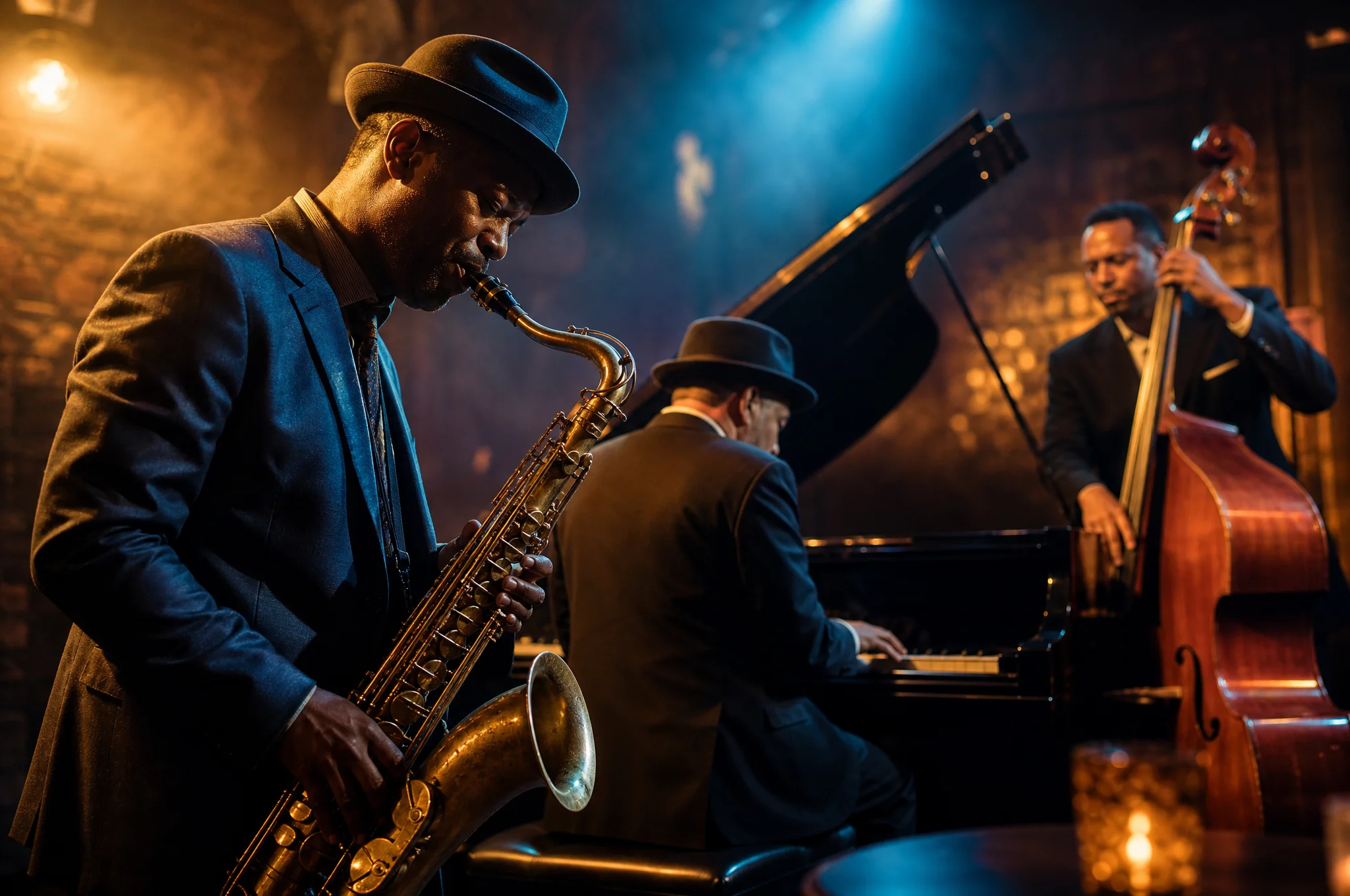
Jazz Music Styles: A Complete Guide to AI Music Creation
Explore jazz music styles and subgenres, and master AI music creation techniques. Create professional jazz music with MusicMake.ai.
What Is Jazz Music?
Jazz is a music genre born in early 20th-century New Orleans, defined by improvisation, complex harmonic language, and a distinctive Swing Feel. It is considered one of America's most important contributions to world music.
What makes jazz truly unique is improvisation — musicians freely create within an established harmonic framework, producing one-of-a-kind musical moments. In the realm of AI music creation, jazz's complex harmonies and improvisational elements provide an exciting challenge for AI models, and MusicMake.ai can generate music that captures the essence of jazz.
From a music theory perspective, jazz harmony is far more complex than pop music. Jazz builds on seventh chords and extends to ninth, eleventh, and thirteenth chords. Tritone substitutions, borrowed chords, and various reharmonization techniques give jazz harmony its rich color. The II-V-I progression is the most essential harmonic pattern in jazz, appearing in nearly every jazz standard.
Jazz rhythm also has its own distinctive character. Swing Feel is the heartbeat of jazz — it treats eighth notes as uneven triplets, creating a unique groove. The application of Latin rhythms like Bossa Nova and Samba within jazz, along with the development of Afro-Cuban Jazz, has further enriched jazz's rhythmic dimensions.
Jazz performance culture emphasizes interaction and dialogue among musicians. In a typical jazz performance, musicians take turns soloing while the others provide accompaniment and support. This collective improvisation is the most captivating aspect of jazz — every performance is a unique musical experience.
MusicMake.ai provides jazz music creators with a complete toolkit from concept to finished product. Whether you want to create a Smooth Jazz piece or explore the complex harmonies of Bebop, MusicMake.ai's AI models can quickly generate professional-grade jazz music.
Core Characteristics of Jazz Music
- Improvisation: The most essential feature of jazz — musicians freely create within a harmonic framework
- Swing rhythm: A distinctive Swing Feel that gives the rhythm its groove
- Complex harmony: Extensive use of seventh, ninth, eleventh chords, and substitute chords
- Instrumental dialogue: Improvised conversations and call-and-response between musicians
- Blues roots: Jazz draws heavily from blues music elements
- Personalized tone: Every jazz musician has a unique sound and playing style
- Standard repertoire: Improvisation based on classic standards from the "Real Book"
- Live energy: Jazz is at its best in live performance
- Chord substitution: Rich chord substitution techniques add harmonic color
- Rhythmic freedom: Jazz rhythm allows for considerable flexibility and elasticity
History of Jazz Music
Jazz traces its origins to late 19th and early 20th-century New Orleans, where African American communities blended blues, ragtime, and march music to create an entirely new musical form. As a port city, New Orleans brought together diverse cultures from Africa, the Caribbean, and Europe, providing fertile ground for jazz's birth.
Louis Armstrong was the most influential early jazz trumpeter, elevating improvisation to the core of jazz. His Hot Five and Hot Seven recordings established the tradition of jazz soloing. Duke Ellington, through his big band arrangements and compositional genius, elevated jazz to the artistic heights of classical music.
In the 1920s, jazz spread from New Orleans to Chicago and New York in what became known as the "Jazz Age." This era's jazz was characterized by collective improvisation and lively rhythms, becoming a vital part of American popular culture. In the 1930s, Duke Ellington and Benny Goodman led the Big Band era, and Swing became America's most popular dance music.
In the 1940s, Charlie Parker and Dizzy Gillespie invented Bebop, pushing jazz to even greater artistic heights. Bebop featured rapid chord changes, complex melodies, and small-group formats, marking jazz's transformation from dance music to art music.
The 1950s and 1960s were an era of jazz diversification. Miles Davis pioneered Cool Jazz and Fusion, and his album "Kind of Blue" became the best-selling jazz album of all time. John Coltrane explored the boundaries of Free Jazz, and his album "A Love Supreme" is regarded as jazz's sacred text. Since then, jazz has continued to fuse with rock, electronic, hip-hop, and other styles, maintaining its vitality.
Creating Jazz Music with MusicMake.ai
MusicMake.ai offers multiple ways to create jazz music, from traditional Swing to modern Fusion, catering to various moods:
Using AI Music Generator
Visit the Generate page and enter your jazz music ideas. The AI Style Generator can help you precisely select subgenre parameters like Bebop, Cool Jazz, or Fusion.
In Simple mode, just enter a brief description like "make a Smooth Jazz" and the AI will automatically expand it into a full musical description. In Custom mode, you can precisely control harmonic complexity, instrument configuration, Swing intensity, and other parameters.
Using Music Agent
Chat with the Music Agent and describe your desired jazz music in natural language:
- "Make a Smooth Jazz piece with saxophone as the lead"
- "Create a Bebop jazz track with fast improvisational passages"
- "Make a Jazz Hop beat with jazz samples over hip-hop drums"
- "Create a Bossa Nova jazz piece with Brazilian flavor"
Music Agent supports multi-turn conversations, so you can continue refining the harmony, instruments, and mood based on the generated results.
Using AI Style Generator
Explore various jazz subgenre combinations in the AI Style Generator. You can try crossover blends like "Jazz + Electronic" or "Bebop + Hip-Hop" to discover unique jazz styles.
Jazz Music Subgenres
Jazz subgenres are rich and diverse, from traditional Swing to modern Fusion, each with its own distinctive musical characteristics:
| Subgenre | Description | Signature Features |
|---|---|---|
| New Orleans Jazz | The earliest jazz style | Brass band, collective improvisation, march rhythms |
| Swing | Big band era jazz | Big band ensemble, danceability, swing rhythm |
| Bebop | Fast, complex jazz | Rapid chord changes, complex melodies, small group |
| Cool Jazz | Soft, restrained style | Mellow tone, restrained playing, West Coast style |
| Hard Bop | More intense jazz | Blues influence, gospel elements, powerful playing |
| Modal Jazz | Scale-based rather than chord-based | Extended improvisation, spacious feel, meditative atmosphere |
| Free Jazz | Breaking traditional rules | No fixed harmony, free rhythm, experimental |
| Fusion | Jazz meets rock | Electric instruments, rock rhythms, jazz harmony |
| Smooth Jazz | Accessible, easy-listening style | Flowing melodies, mellow tone, background music feel |
| Jazz Hop | Jazz samples meet hip-hop | Jazz samples, Boom Bap beats, Lo-fi |
| Latin Jazz | Latin jazz | Latin percussion, African rhythms, jazz improvisation |
| Gypsy Jazz | Gypsy jazz | Guitar-driven, accordion, fast playing |
| Acid Jazz | Acid jazz | Funk elements, dance rhythms, DJ culture |
| Jazz Fusion | Modern fusion jazz | Electronic elements, complex arrangements, crossover fusion |
| Post-Bop | Post-bop | Modern jazz, Bebop foundation, innovative harmony |
| Spiritual Jazz | Spiritual jazz | Meditative atmosphere, Eastern influences, deep exploration |
| Chamber Jazz | Chamber jazz | Classical influence, refined arrangements, small ensemble |
| Nu Jazz | Nu jazz | Electronic elements, jazz foundation, modern production |
| Avant-Garde Jazz | Avant-garde jazz | Extreme experimentation, free form, boundary-pushing |
| Cool West Coast | West Coast cool jazz | Mellow tone, refined arrangements, relaxed atmosphere |
| Soul Jazz | Soul jazz | Soul influence, organ, blues feel |
| Ethio-Jazz | Ethiopian jazz | African scales, unique rhythms, exotic flavor |
| Afro-Cuban Jazz | Afro-Cuban jazz | Cuban rhythms, rich percussion, tropical energy |
| Third Stream | Third stream | Fusion of classical and jazz, orchestral arrangements |
Best Practices for Jazz Music Creation
- Focus on harmonic color: The charm of jazz lies in rich harmony — use extended and substitute chords liberally
- Leave room for improvisation: Jazz needs "breathing" space — don't fill every measure
- Instrument choice matters: Saxophone, trumpet, piano, bass, and drums are the classic jazz quintet
- Reference the Real Book: Classic jazz standards are the best resource for learning jazz harmony and melody
- Master Swing Feel: Swing is the most essential rhythmic characteristic of jazz — understand the triplet feel
- Emphasize tonal personality: Jazz musicians all have unique tones — pay attention to tone selection in AI creation
- Learn standards: Familiarize yourself with classics like "Autumn Leaves" and "All The Things You Are"
- Think improvisationally: Even with AI-generated jazz, maintain the spirit of improvisation and freedom
Frequently Asked Questions
Common questions and answers about jazz music creation:
Can AI-generated jazz music be used commercially?
Yes. Music created with MusicMake.ai carries no commercial risk — you can confidently use it in commercial projects, restaurant background music, video soundtracks, and more. All music generated through the platform comes with full commercial licensing.
Can AI generate improvisation?
MusicMake.ai's AI models can generate jazz music with an improvisational feel, including solo passages. You can specify descriptions like "with an improvised saxophone solo" or "piano improvisation section" in your prompts. The AI can simulate different styles of improvisation, from Bebop's rapid notes to Cool Jazz's restrained expression.
How can I make AI-generated jazz sound more authentic?
Specify the exact subgenre (e.g., "1950s Cool Jazz"), instrument combination (e.g., "piano trio"), and mood descriptions (e.g., "intimate late-night bar feel") in your prompts to help the AI generate more authentic jazz. You can also specify a recording era style, such as "1950s studio warmth."
What are typical jazz harmonies?
Jazz is built on seventh chords, commonly using major sevenths (Maj7), minor sevenths (m7), dominant sevenths (7), and half-diminished sevenths (m7b5). Advanced jazz harmony also includes ninth, eleventh, thirteenth chords, and various substitute chords. The II-V-I progression is the most essential harmonic pattern in jazz.
Can AI-generated jazz be used as restaurant background music?
Yes. Jazz music generated with MusicMake.ai is perfect for restaurants, cafés, bars, and similar venues. Styles like Smooth Jazz and Cool Jazz, with their mellow tones and relaxed atmosphere, add elegance to commercial spaces.
How can I make AI-generated jazz more relaxing?
Specify "Smooth Jazz," "relaxed," "background music," and "mellow tone" in your prompts to help the AI generate more relaxing jazz. You can also lower the BPM (80-100) and reduce instrument density to enhance the laid-back feel.