Hip-Hop/Rap Music Style: Complete Guide to AI Music Creation
Explore hip-hop/rap music styles and subgenres, and master AI music production techniques. Create professional-grade hip-hop music with MusicMake.ai.
What Is Hip-Hop/Rap Music?
Hip-Hop/Rap music was born at street parties in the Bronx, New York, during the 1970s and has since become one of the most influential music cultures in the world. Its core characteristics include rhythmic spoken-word delivery (Rapping), sampled or synthesized beats, and rich cultural storytelling.
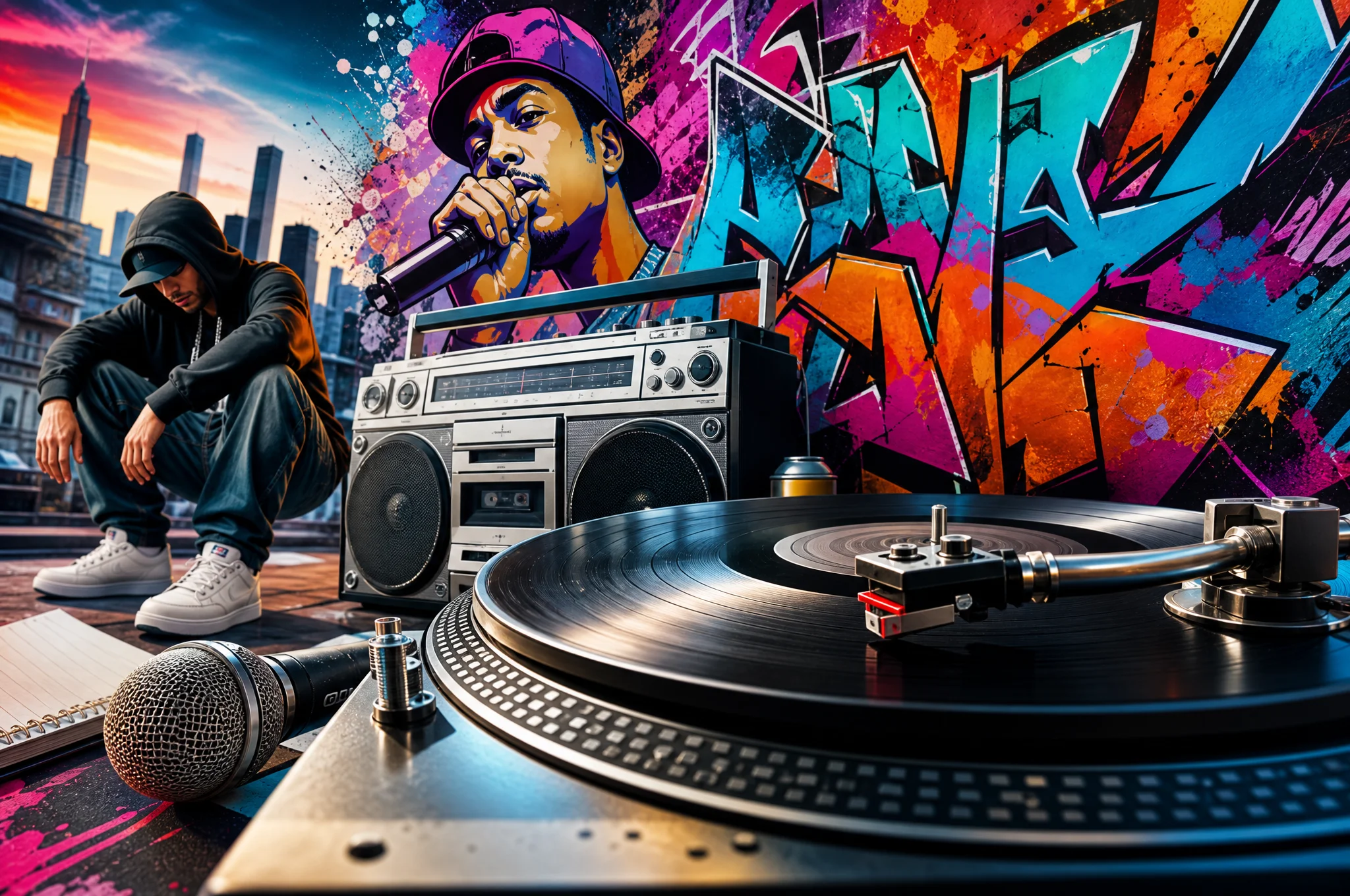
Hip-hop is more than just a music genre — it's a complete cultural expression system encompassing DJing, graffiti, breakdancing, and fashion. In the realm of AI music creation, beat production and arrangement are among the areas where AI excels the most, allowing creators to quickly generate various styles of Beats and focus on lyrics and flow.
From a technical standpoint, the foundation of hip-hop production lies in the beat. A typical hip-hop beat consists of a Kick, Snare, and Hi-hat, combined with a bassline and melodic elements. Modern hip-hop extensively uses 808 drum machine sounds — a classic tone originating from the Roland TR-808, renowned for its deep sub-bass and crisp Hi-hat.
The cultural significance of hip-hop extends far beyond music itself. It has evolved from an art form in marginalized communities into a dominant force in global pop culture, influencing fashion, language, visual arts, and social movements. Each generation of hip-hop artists has pushed this culture forward — from Old School to Trap, from Boom Bap to Drill, hip-hop has always maintained its vigorous spirit of innovation.
MusicMake.ai provides powerful tools for hip-hop creators. Whether you want to produce a simple Beat or explore complex style fusions, MusicMake.ai's AI models can quickly generate professional-grade hip-hop music.
Core Characteristics of Hip-Hop/Rap
- Rhythm-driven: Powerful drum machine beats form the backbone of hip-hop, typically built on Boom Bap or Trap rhythms
- Rapping: Rhythmic verbal delivery emphasizing rhyme schemes, flow, and rhythmic feel
- Sampling culture: Extracting segments from existing music for rearrangement and new creation
- Bass-heavy: 808 sub-bass is the signature sound of modern hip-hop
- Loop structure: Building songs from repeated musical phrases
- Producer-led: Producers play a central creative role in hip-hop
- Narrative-driven: Lyrics often tell personal stories, social observations, and cultural attitudes
- Highly diverse styles: From hardcore to Trap, from Boom Bap to Drill, subgenres are extremely rich
- Flow variation: A rapper's flow is a key marker of stylistic distinction
- Beat Switch: Modern hip-hop frequently switches between different beat styles within a single song
History of Hip-Hop/Rap
The origins of hip-hop trace back to 1973, when DJ Kool Herc first used the "breakbeat" technique at a party in the Bronx, New York, extending drum breaks to give dancers more time to perform. This innovation laid the foundation for hip-hop, and DJ culture became one of its core elements.
In the 1980s, Grandmaster Flash and Run-DMC brought hip-hop into the mainstream market. During this era, hip-hop began transitioning from underground parties to commercial stages, and record labels started paying attention to this emerging culture. Beastie Boys' Licensed to Ill became the first hip-hop album to top the Billboard 200.
The 1990s were the golden age of hip-hop. The East Coast, represented by Nas, Wu-Tang Clan, and The Notorious B.I.G., was known for complex lyricism and sample-based production. The West Coast, represented by Tupac, Dr. Dre, and Snoop Dogg, developed the distinctive G-Funk style. The rivalry between the two coasts fueled rapid growth in hip-hop.
After the 2000s, Kanye West broke traditional hip-hop production conventions by incorporating soul samples and electronic elements into beat-making. Jay-Z, Drake, and others pushed hip-hop to the pinnacle of global pop culture. Trap became the dominant hip-hop style of the 2010s, with artists like Migos, Future, and Travis Scott leading the trend.
Today, hip-hop is one of the most streamed music genres worldwide. AI technology has made beat production more efficient, enabling creators to obtain professional-grade hip-hop instrumentals in seconds.
Creating Hip-Hop Music with MusicMake.ai
MusicMake.ai offers multiple ways to create hip-hop music, from beat production to full song creation, catering to various skill levels:
Using AI Music Generator
Visit the Generate page and describe your desired hip-hop style. The AI Style Generator helps you precisely select subgenre parameters like Trap, Boom Bap, or Drill.
In Simple mode, just enter a brief description like "make a Trap beat," and the AI will automatically expand it into a full musical description. In Custom mode, you can precisely control BPM, drum kit style, bass intensity, and other parameters to craft hip-hop music that perfectly matches your vision.
Using Music Agent
Chat with the Music Agent and describe your desired hip-hop music in natural language:
- "Make a Trap-style beat with heavy 808 bass"
- "Create an old-school Boom Bap hip-hop instrumental"
- "Make a Drill-style beat with a dark, ominous vibe"
- "Create a Lo-fi Hip-Hop track, something chill to study to"
Music Agent supports multi-turn conversations, so you can keep refining based on the generated results until you get the perfect Beat.
Using AI Style Generator
Explore various hip-hop subgenre combinations in the AI Style Generator. You can blend different style elements, such as "Jazz + Trap" or "Lo-fi + Drill," to discover unique hip-hop styles.
Hip-Hop/Rap Subgenres
Hip-hop boasts an incredibly rich array of subgenres, each with its own distinct musical characteristics and cultural background:
| Subgenre | Description | Signature Characteristics |
|---|---|---|
| Trap | The most popular modern hip-hop style | 808 drum machine, rapid Hi-hat rolls, sub-bass |
| Boom Bap | Classic East Coast hip-hop | Sampled drums, jazzy samples, hardcore lyricism |
| Drill | Hardcore style originating from Chicago | Dark melodies, sliding 808s, street narratives |
| Lo-fi Hip-Hop | Lo-fi hip-hop for studying and relaxing | Sampled noise, slow beats, ambient feel |
| Old School | 70s–80s hip-hop pioneer style | Simple drum machines, party themes, DJ scratching |
| Conscious Hip-Hop | Hip-hop focused on social issues | Deep lyrics, soul samples, narrative-driven |
| Gangsta Rap | Hardcore street rap | Aggressive lyrics, heavy beats, raw storytelling |
| Cloud Rap | Dreamy, atmospheric hip-hop | Heavy reverb, Auto-tune, ethereal melodies |
| Mumble Rap | Melodic, mumbled vocal rap | Melodic hooks, Auto-tune, repetitive lyrics |
| Latin Trap | Fusion of Latin rhythms and Trap | Latin percussion, Spanish language, Reggaeton |
| Afro Hip-Hop | Fusion of African rhythms and hip-hop | Afrobeat drums, African percussion |
| Horrorcore | Horror-themed hip-hop | Dark lyrics, horror samples, eerie atmosphere |
| Jazz Rap | Fusion of jazz samples and hip-hop | Jazz chords, saxophone samples, laid-back vibes |
| Emo Rap | Emotional hip-hop | Guitar samples, melancholic lyrics, punk elements |
| UK Drill | British version of Drill | Rapid Hi-hat, London accent, Grime elements |
| Trap Metal | Fusion of Trap and metal | Distorted 808s, screamed vocals, aggressive energy |
| Plugg | Dreamy Trap | Soft 808s, ethereal melodies, slow tempo |
| Rage | Aggressive Trap | Synth leads, high energy, festival-oriented |
| Phonk | Retro hip-hop | Memphis samples, lo-fi texture, dark atmosphere |
| Drill UK | Branch of UK Drill | Fast tempo, London accent, Grime influence |
| Abstract Hip-Hop | Experimental hip-hop | Experimental production, unconventional structure, artistic |
| Chopped and Screwed | Slowed and chopped hip-hop | Pitch-shifted samples, DJ Screw style, psychedelic feel |
| Crunk | High-energy hip-hop | High energy, synth hooks, party themes |
| Snap Music | Hip-hop dance music | Handclap beats, minimal production, danceable |
| Bounce | New Orleans bounce | Fast tempo, call and response, danceable |
Best Practices for Hip-Hop Music Production
- Start with the drums: The beat is the core of hip-hop — establish your drum pattern first, then layer melodic elements
- Prioritize bass: 808 bass is the soul of modern hip-hop; ensure the low end is powerful but not muddy
- Leave space: Carve out frequency space for the rapper's vocals to avoid overcrowded arrangements
- Use sampling wisely: Sampling is the foundation of hip-hop culture; draw inspiration from music across different genres
- Focus on groove: The groove in hip-hop comes from the interplay between drums and bass; make sure it feels strong
- Control density: Don't overfill the arrangement — space is equally important, leaving room for vocals and flow to shine
- Tune your 808s: Ensure the 808 bass is in key with the song to avoid low-frequency muddiness
- Vary your Hi-hats: Subtle Hi-hat variations in Trap music are key to defining your style
FAQ
Common questions and answers about hip-hop music creation:
Can AI-generated hip-hop music be used commercially?
Yes. Music generated by MusicMake.ai carries no commercial risk. You can confidently use it for commercial projects, video soundtracks, and more. All music generated through the platform comes with full commercial licensing.
Can AI generate hip-hop songs with lyrics?
MusicMake.ai primarily focuses on music generation. You can use AI to generate a Beat first, then record your own rapping vocals, or use the Music Agent to try full song creation. Music Agent supports natural language conversation and can help you through the entire process from concept to finished product.
How can I make AI-generated hip-hop Beats more unique?
Specifying a particular subgenre (e.g., "90s East Coast Boom Bap"), mood (e.g., "dark, tense"), and instrumental characteristics (e.g., "with piano samples") in your prompts helps the AI generate output that better matches your vision. You can also specify a BPM range and drum kit style for more precise control.
What's the difference between Trap and Boom Bap?
Trap is the dominant modern hip-hop style, characterized by 808 drum machines, rapid Hi-hat rolls, and sub-bass, typically at 130–160 BPM. Boom Bap is a classic 90s East Coast style defined by sampled drums and jazzy samples, usually at 85–95 BPM. The two differ significantly in rhythm patterns, sound selection, and production techniques.
Can AI-generated hip-hop music be used for short videos?
Absolutely. Hip-hop music generated by MusicMake.ai is perfect for short videos, vlogs, gaming streams, and other content creation. You can generate Beats in various lengths and styles to suit different content needs.
How can I make AI-generated hip-hop Beats better suited for rapping?
Include descriptions like "leave space for vocals," "minimal arrangement," and "clear drums" in your prompts to help the AI generate Beats that are better suited for rapping. Avoid overly complex melodies and excessive instrumental layers to ensure the rapper's voice cuts through the mix clearly.