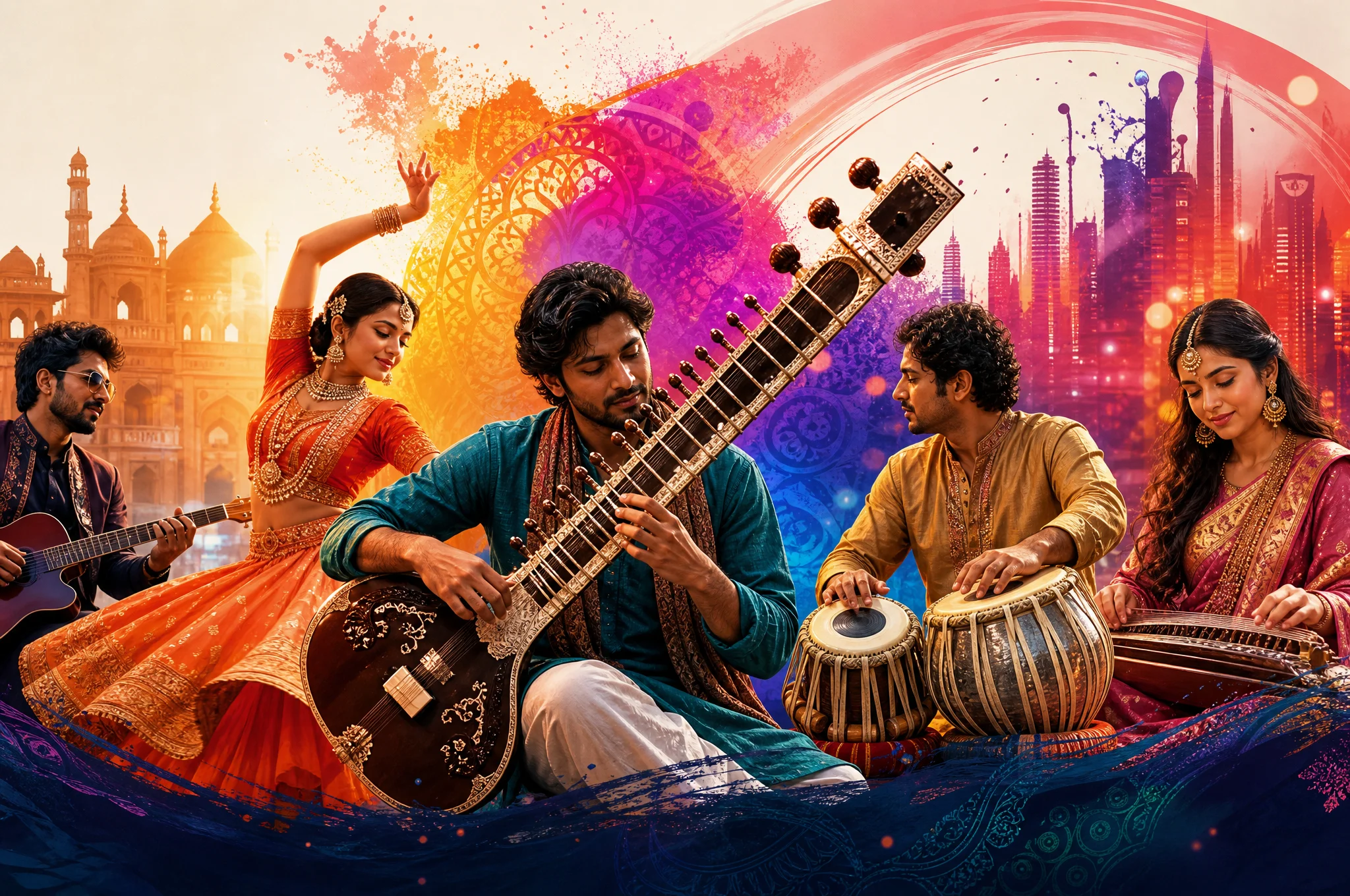
Asian Music Styles: A Complete Guide to AI Music Creation
Explore Asian music styles and subgenres, and master AI music creation techniques. Create professional Asian music with MusicMake.ai.
What Is Asian Music?
Asian music encompasses a vast range of musical traditions stretching from East Asia to Southeast Asia, South Asia, and Central Asia. This enormous musical treasury includes Chinese classical music, Indian ragas, Japanese gagaku, Indonesian gamelan, Arabic maqam, and countless other unique and sophisticated musical systems.
The heart of Asian music lies in the diversity of melody and modes. Unlike Western music, which is built primarily on the major-minor system, Asian music employs a variety of distinctive scales and modes — from the Chinese pentatonic scale to Indian ragas, from the Japanese miyako-bushi scale to Arabic maqam. These unique scale systems give Asian music its irreplaceable exotic beauty.
For AI music creation, Asian music is a field rich with exploration potential. Understanding the scales, instruments, and aesthetic principles of different Asian musical traditions is key to generating high-quality Asian-style music.
Core Characteristics of Asian Music
- Distinctive scale systems: Pentatonic scales, ragas, maqam, miyako-bushi, and more
- Traditional instruments: Guzheng, erhu, sitar, shakuhachi, gamelan, and other distinctive instruments
- Melody-driven: Compared to Western music's harmonic system, Asian music emphasizes melodic lines
- Ornamentation and microtones: Extensive use of slides, trills, and microtonal intervals
- Improvisatory tradition: Improvisation within fixed frameworks, such as Indian raga improvisation
- Ritual and spiritual function: Much Asian music is closely tied to religion, meditation, and ceremony
- Oral transmission: Traditional music learning emphasizes master-apprentice lineage
- Regional diversity: Every country and region has its own unique musical traditions
History of Asian Music
Asian music's history spans thousands of years. China's ancient ritual music system, India's Vedic hymns, and Japan's gagaku tradition all reveal the deep roots of Asian music. These traditions have evolved throughout history while maintaining their core aesthetic principles.
From the late 19th to early 20th century, Western music began influencing Asia. Japan's Meiji Restoration and China's Self-Strengthening Movement both introduced Western musical elements. This fusion gave rise to new musical forms — such as Chinese popular music (Shanghai-era songs), Japanese enka, and modern J-Pop.
In the 21st century, Asian popular music has become a global cultural force. K-Pop, J-Pop, C-Pop, and other modern Asian pop genres blend Western production techniques with Asian aesthetics to create a distinctive sound. Meanwhile, traditional music is experiencing a revival and creative renewal.
Creating Asian Music with MusicMake.ai
MusicMake.ai offers multiple ways to create Asian music:
Method 1: Using AI Music Generator
Visit the Generate page and enter your desired Asian style description. The built-in AI Style Generator can help you transform vague ideas into precise Asian style descriptions.
Method 2: Using Music Agent
Tell the Music Agent the Asian style you want, for example:
- "Make a Chinese-style pop song using pentatonic scales and guzheng"
- "Create a piece in Indian raga style with sitar and tabla"
- "Make something in Japanese enka style, expressing melancholy and beauty"
Method 3: Using AI Style Generator
The AI Style Generator can help you explore various Asian music subgenres, automatically generating style descriptions that include scales, instruments, and cultural elements.
Asian Music Subgenres
| Subgenre | Region | Characteristics | Representative Artists/Works |
|---|---|---|---|
| Chinese Classical | China | Pentatonic scale, silk and bamboo instruments | "High Mountains Flowing Water," "Moonlit River in Spring" |
| Chinese Folk | China | Regional characteristics, traditional instruments | Erhu, pipa, guzheng repertoire |
| C-Pop | China | Modern Chinese pop | Jay Chou, G.E.M. |
| J-Pop | Japan | Japanese pop, anime music | Hikaru Utada, Kenshi Yonezu |
| Enka | Japan | Japanese traditional ballad, emotional expression | Sayuri Ishikawa, Kiyoshi Hikawa |
| K-Pop | South Korea | Korean pop, visual performance | BTS, BLACKPINK |
| Indian Classical | India | Raga system, tala rhythm | Ravi Shankar, Zakir Hussain |
| Bollywood | India | Film music, dance rhythms | A.R. Rahman |
| Gamelan | Indonesia | Bronze percussion, cyclical structure | Traditional gamelan ensemble |
| Tarab | Southeast Asia | Arab and local fusion | Siti binti Saad |
| Vietnamese Folk | Vietnam | Dan bau, moon lute | Traditional Vietnamese music |
| Thai Classical | Thailand | Thai scales, refined arrangements | Traditional Thai court music |
| Mongolian Throat Singing | Mongolia | Throat singing, morin khuur | Huun-Huur-Tu |
| Central Asian Music | Central Asia | Silk Road influence, nomadic traditions | Traditional Central Asian music |
Asian Music Prompt Examples
Here are reference prompts for generating Asian music with MusicMake.ai:
Chinese-style Pop:
"A Chinese-style pop song with pentatonic melody, guzheng and erhu timbres, modern R&B beat fusion, Jay Chou style, blending classical yijing with modern sensibility."
Indian Raga:
"An Indian raga-style piece with sitar lead, tabla accompaniment, progressive improvisation, meditative atmosphere, Ravi Shankar style."
Japanese Enka:
"A Japanese enka-style song with shakuhachi and shamisen timbres, melancholic melody, miyako-bushi scale, blending tradition with modernity."
K-Pop:
"A K-Pop song with catchy melody, electronic beats, synth textures, multi-layered vocal arrangement, a blend of BTS and BLACKPINK style."
MusicMake.ai — No Commercial Risk
Asian music created with MusicMake.ai carries no commercial risk. All AI-generated music can be used for personal projects, commercial purposes, video soundtracks, game audio, and more — with no copyright concerns. This gives you the freedom to use your generated Asian music across all kinds of creative and commercial projects.
Recommended MusicMake.ai Features
| Feature | Use Case | Link |
|---|---|---|
| AI Music Generator | Quickly generate Asian music clips | Generate |
| Music Agent | Conversational creation with precise style control | Chat |
| AI Style Generator | Explore Asian subgenre combinations | Style Generator |
| AI Prompt Enhancer | Expand simple ideas into complete descriptions | Generate |
Blending Asian Music with Other Genres
Asian music's unique timbres make it a creative treasure trove for cross-genre fusion:
- Asian + Pop: C-Pop, J-Pop, and K-Pop are fusions of Asian tradition and modern pop
- Asian + Electronic: Electronic Asian music has gone viral on TikTok worldwide
- Asian + Jazz: Fusion jazz incorporating Asian scales and traditional instruments
- Asian + Rock: Japanese visual kei rock and Chinese rock incorporate traditional elements
- Asian + Hip-Hop: Asian hip-hop blends traditional instruments with modern beats
In MusicMake.ai, you can explore these fusion styles through combined descriptions, such as "Chinese-style + R&B" or "Japanese traditional + electronic beats."
Best Practices for Asian Music AI Creation
-
Specify the region and tradition: Asian music varies enormously internally. Be clear whether you want East Asian, South Asian, Southeast Asian, or Central Asian style, and whether it should be traditional or a modern fusion.
-
Specify the scale type: Much of Asian music's character comes from its distinctive scales. Use terms like "pentatonic," "raga," or "miyako-bushi."
-
Describe instrumental timbres: The timbres of Asian traditional instruments are highly distinctive. Specify instrument names in your prompts (such as "erhu," "sitar," or "shakuhachi") for more accurate results.
-
Consider aesthetic principles: Different Asian musical traditions have different aesthetics — Chinese music's "yijing" (artistic conception), Japanese music's "ma" (space/silence), and Indian music's "rasa" (emotional essence). Understanding these concepts helps generate more authentic music.
-
Blend in modern elements: Modern Asian pop (such as C-Pop and K-Pop) incorporates extensive Western production techniques. Specify the balance between traditional and modern in your prompts.
FAQ
Can AI generate authentic traditional Asian music?
MusicMake.ai has been trained on extensive Asian music and can generate works with Asian musical characteristics. However, for highly traditional or ceremonial music, AI-generated pieces may lack the subtle emotional expression of human performers. It's recommended to use AI-generated works as a starting point and have musicians familiar with the tradition refine them.
What is the role of the pentatonic scale in Asian music?
The pentatonic scale (do-re-mi-sol-la) is the foundation of traditional music in China, Japan, Korea, Vietnam, and other East and Southeast Asian countries. It also forms the basis of many folk and blues traditions. Specifying "pentatonic scale" in your prompts can generate melodies with an Eastern flavor.
Which Asian traditional instruments does MusicMake.ai support?
MusicMake.ai can simulate the timbres of various Asian traditional instruments, including guzheng, erhu, pipa, dizi, sitar, tabla, shakuhachi, shamisen, and more. Specifying instrument names in your prompts will yield more accurate results.