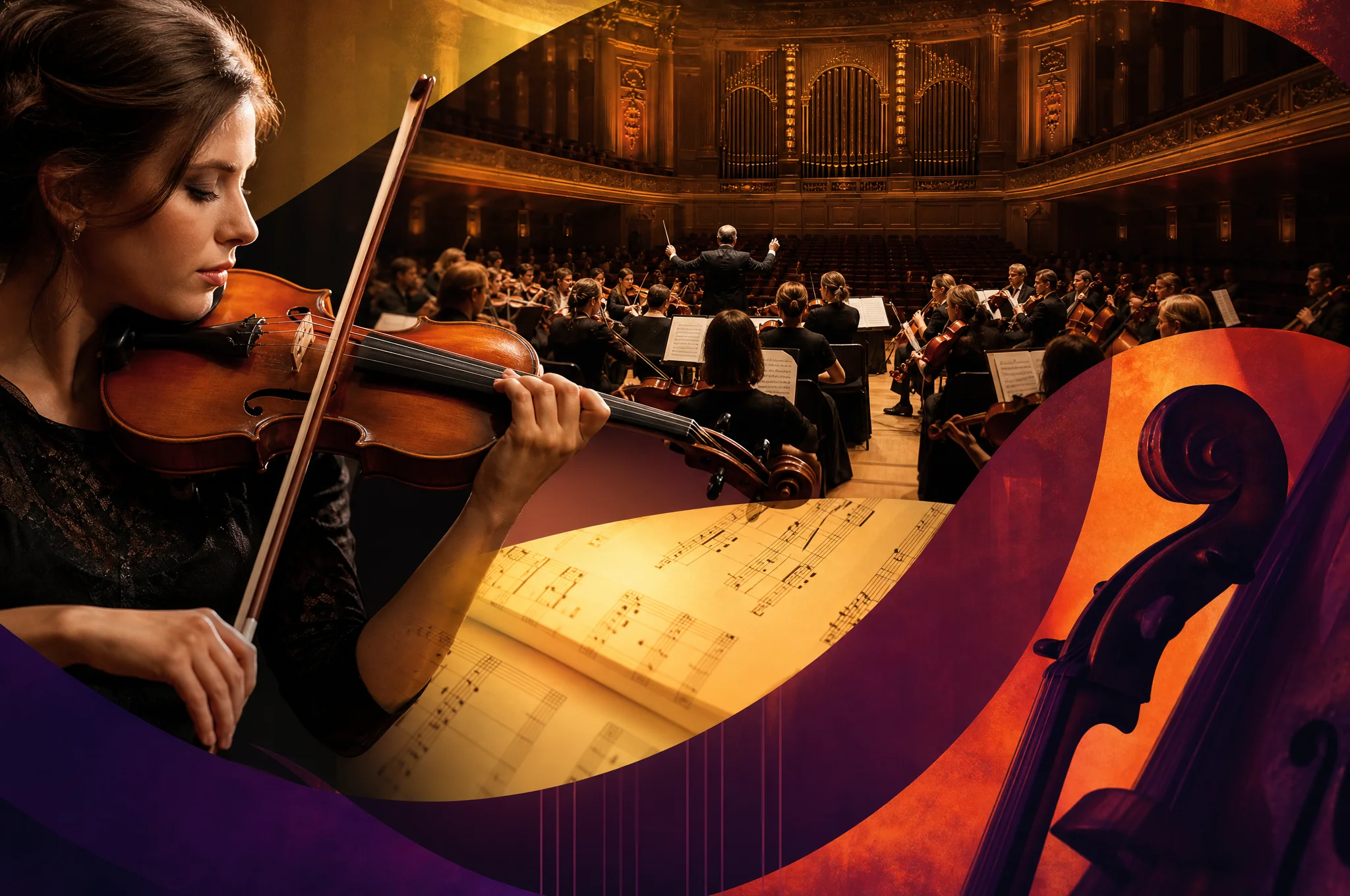
Classical Music Styles: A Complete Guide to AI Music Creation
Explore classical music styles and subgenres, and master AI music creation techniques. Create professional classical music with MusicMake.ai.
What Is Classical Music?
Classical Music is the most important part of the Western art music tradition, encompassing a vast repertoire from the 17th century to the present day. Built on orchestral arrangements, complex formal structures, and deep music theory, it represents one of humanity's greatest artistic achievements.
Creating classical music requires a solid foundation in music theory, including harmony, counterpoint, orchestration, and formal analysis. In AI music creation, classical music is an extremely challenging genre, but MusicMake.ai's models can generate music with a classical sensibility, helping creators quickly find inspiration or produce complete orchestral arrangements.
From a technical standpoint, classical music's harmonic language has evolved from medieval modal systems to modern atonality and serialism. Baroque-era Basso Continuo and Counterpoint laid the foundations of Western harmony. The Classical period established homophony — the melody-plus-accompaniment texture. The Romantic period developed even richer and more complex harmonic language, including chromaticism and distant key modulations.
Orchestration is also a profound discipline. A symphony orchestra comprises four instrument families — strings, woodwinds, brass, and percussion — each with its own unique tonal characteristics. Composers must understand each instrument's range, technical limitations, and timbral qualities to write effective orchestral scores. Chamber music, with smaller ensembles like string quartets and piano trios, showcases exquisite musical dialogue.
Performance practice is equally important. Music from different periods has different performance styles and conventions, from Baroque ornamentation to Romantic rubato — performers must deeply understand the historical context to deliver appropriate interpretations.
MusicMake.ai provides classical music creators with a complete toolkit from concept to finished product. Whether you want to create a Baroque-style string piece or explore Romantic orchestral music, MusicMake.ai's AI models can quickly generate professional-grade classical music.
Core Characteristics of Classical Music
- Orchestral forces: Full symphony orchestra or chamber ensemble
- Complex forms: Sonata form, rondo form, theme and variations, and other traditional structures
- Rich harmony: From Baroque counterpoint to Romantic chromaticism
- Wide dynamic range: From the softest pianissimo to the most powerful fortissimo
- Emotional depth: Classical music pursues the deepest levels of emotional expression
- Theoretical rigor: Built on a solid foundation of music theory
- Historical lineage: Each era has its own distinctive stylistic features
- Performance tradition: Emphasis on performance technique and musical interpretation
- Multi-movement structure: Large-scale works typically consist of multiple movements
- Precise notation: Composers record musical intentions through detailed scores
History of Classical Music
Classical music's history traces back to medieval church music, with Gregorian Chant being one of the earliest forms of Western music. During the Renaissance, polyphonic music flourished, and composers like Palestrina and Josquin des Prez created exquisite multi-voice works.
The 17th-century Baroque era marked the formal birth of classical music. J.S. Bach composed immortal masterpieces like "The Well-Tempered Clavier" and "St. Matthew Passion" with his masterful counterpoint. Handel's oratorio "Messiah" and Vivaldi's violin concerto "The Four Seasons" remain concert staples to this day.
During the 18th-century Classical period, Haydn established the standard forms of the symphony and string quartet, earning the title "Father of the Symphony." Mozart, with his extraordinary melodic genius, created pinnacle works in opera, symphony, and concerto. Beethoven, through works like his "Ninth Symphony," pushed classical music to the threshold of Romanticism.
In the 19th-century Romantic period, Chopin's piano music, Liszt's virtuosic works, Tchaikovsky's ballet music, and Mahler's symphonies brought classical music to the peak of emotional expression. Composers of this era placed greater emphasis on personal emotion and programmatic music.
In the 20th century, movements like Debussy's Impressionism, Schoenberg's twelve-tone system, and Stravinsky's Neoclassicism broke traditional rules. Bartók and Kodály integrated folk music elements into classical composition, while Shostakovich and Prokofiev created a wealth of outstanding works under the Soviet system.
In the contemporary era, classical music has deeply merged with electronic music and film scoring. John Williams's film scores and Hans Zimmer's electronic orchestral music demonstrate the continuation of the classical tradition in modern times. AI technology is opening new possibilities for classical music creation, helping more people engage with and contribute to this great musical tradition.
Creating Classical Music with MusicMake.ai
MusicMake.ai offers multiple ways to create classical music, from Baroque to modern, catering to various settings and ensemble needs:
Using AI Music Generator
Visit the Generate page and enter your classical music ideas. The AI Style Generator can help you select style parameters for different periods — Baroque, Classical, Romantic, and more.
In Simple mode, just enter a brief description like "make a Baroque-style string piece" and the AI will automatically expand it into a full musical description. In Custom mode, you can precisely control instrumentation, formal structure, dynamic range, and other parameters.
Using Music Agent
Chat with the Music Agent and describe your desired classical music in natural language:
- "Create a Baroque-style string quartet"
- "Make a Romantic-style piano solo"
- "Create a Mozart-style serenade"
- "Make an epic cinematic orchestral piece"
Music Agent supports multi-turn conversations, so you can continue refining the instrumentation, mood, and structure based on the generated results.
Using AI Style Generator
Explore different classical music periods and genre combinations in the AI Style Generator. You can try crossover blends like "Baroque + Electronic" or "Romantic + Film Score" to discover unique classical music styles.
Classical Music Subgenres
| Subgenre | Description | Signature Features |
|---|---|---|
| Baroque | 1600–1750 | Counterpoint, basso continuo, ornamentation |
| Classical | 1750–1820 | Balanced structure, clear melody, elegant style |
| Romantic | 1820–1900 | Emotional richness, harmonic expansion, programmatic music |
| Impressionism | Late 19th-century French | Coloristic harmony, hazy textures, Eastern influence |
| Expressionism | Early 20th-century atonality | Atonality, chromaticism, extreme emotion |
| Neoclassicism | 20th-century return to classical forms | Classical structure, modern harmony, objectivity |
| Serialism | Tone-row composition | Twelve-tone system, mathematical, rational |
| Minimalism | Repetitive variation of simple elements | Repeating patterns, gradual change, hypnotic feel |
| Contemporary | Late 20th century to present | Experimental, diverse fusion, new technology |
| Opera | Vocal and orchestral drama | Aria, recitative, dramatic |
| Chamber Music | Small ensemble music | String quartet, piano trio |
| Symphony | Large-scale orchestral works | Multi-movement structure, rich orchestration |
| Concerto | Dialogue between soloist and orchestra | Solo virtuosity, orchestral accompaniment |
| Etude | Technical study pieces | High difficulty, musicality equally important |
| Nocturne | Night-inspired pieces | Lyrical melody, gentle accompaniment, romantic atmosphere |
| Ballade | Narrative pieces | Dramatic, emotional depth, storytelling |
| Impromptu | Impromptu-style pieces | Free form, lyricism, piano-centric |
| Prelude | Short standalone pieces | Atmosphere creation, technique showcase, style exploration |
| Scherzo | Humorous, lively pieces | Fast tempo, triple meter, dramatic |
| Rhapsody | Free-form pieces | Folk themes, emotional range, free structure |
| Overture | Opera or ballet opening | Thematic foreshadowing, dramatic, orchestral |
| Lullaby | Soothing pieces | Gentle melody, simple accompaniment, calming feel |
| March | Processional rhythm | Strong downbeat, steady rhythm, ceremonial feel |
| Dance | Music for dance | Triple or duple meter, dance rhythm |
| Study | Technical study pieces | Specific techniques, musicality equally important |
| Bagatelle | Short pieces | Concise form, light atmosphere |
Best Practices for Classical Music Creation
- Understand formal structures: Classical music has strict formal traditions — learn basic structures like sonata form and rondo form
- Focus on orchestration: The combination of different instrumental timbres is a key expressive tool in classical music
- Master harmonic rules: Classical harmony has its own traditional rules, from functional harmony to coloristic harmony
- Study classic works: Listen to classical music from different periods to develop sensitivity to style
- Voice leading matters: Each voice in classical music should have an independent melodic line — avoid parallel fifths and octaves
- Control dynamics: Classical music has a wide dynamic range — the gradual transition from ppp to fff is an important expressive device
- Know your instruments: Each instrument has its own range and technical limitations — understanding these is essential for effective orchestration
- Master counterpoint: Counterpoint is the foundation of classical composition — understand the independence and interaction between voices
Frequently Asked Questions
Common questions and answers about classical music creation:
Can AI-generated classical music be used commercially?
Yes. Music created with MusicMake.ai carries no commercial risk — you can confidently use it in commercial projects, video soundtracks, game music, and more. All music generated through the platform comes with full commercial licensing.
Can AI generate a complete symphony?
MusicMake.ai can generate orchestral works with a classical style. For a complete symphony, you can generate individual movements and then combine them into a full work. Music Agent can help you plan the overall structure and emotional arc of each movement.
How can I make AI-generated classical music sound more historically authentic?
Specify the exact period (e.g., "Baroque era," "late Romantic"), composer style reference (e.g., "Mozart-style"), and instrumentation (e.g., "string quartet") in your prompts to help the AI generate music that better matches a specific historical style. You can also specify a recording style, such as "analog recording" or "concert hall ambiance."
What are the formal structures used in classical music?
Common classical forms include: sonata form (exposition–development–recapitulation), rondo form (ABACABA), theme and variations (theme–variation 1–variation 2...), ternary form (ABA), and free form. A symphony typically has four movements: the first in sonata form, the second a slow movement, the third a minuet or scherzo, and the fourth a fast finale.
Can AI-generated classical music be used for game soundtracks?
Yes. Classical music generated with MusicMake.ai is perfect for game soundtracks, film scores, documentaries, and more. You can generate classical music matching different game scenes, such as "epic battle," "peaceful village," or "mysterious dungeon."
How can I make AI-generated classical music sound more cinematic?
Emphasize descriptions like "film score," "epic," "orchestral climax," and "Hans Zimmer style" in your prompts to help the AI generate more cinematic classical music. You can also specify techniques like "brass climax" or "string crescendo" for more targeted orchestration.