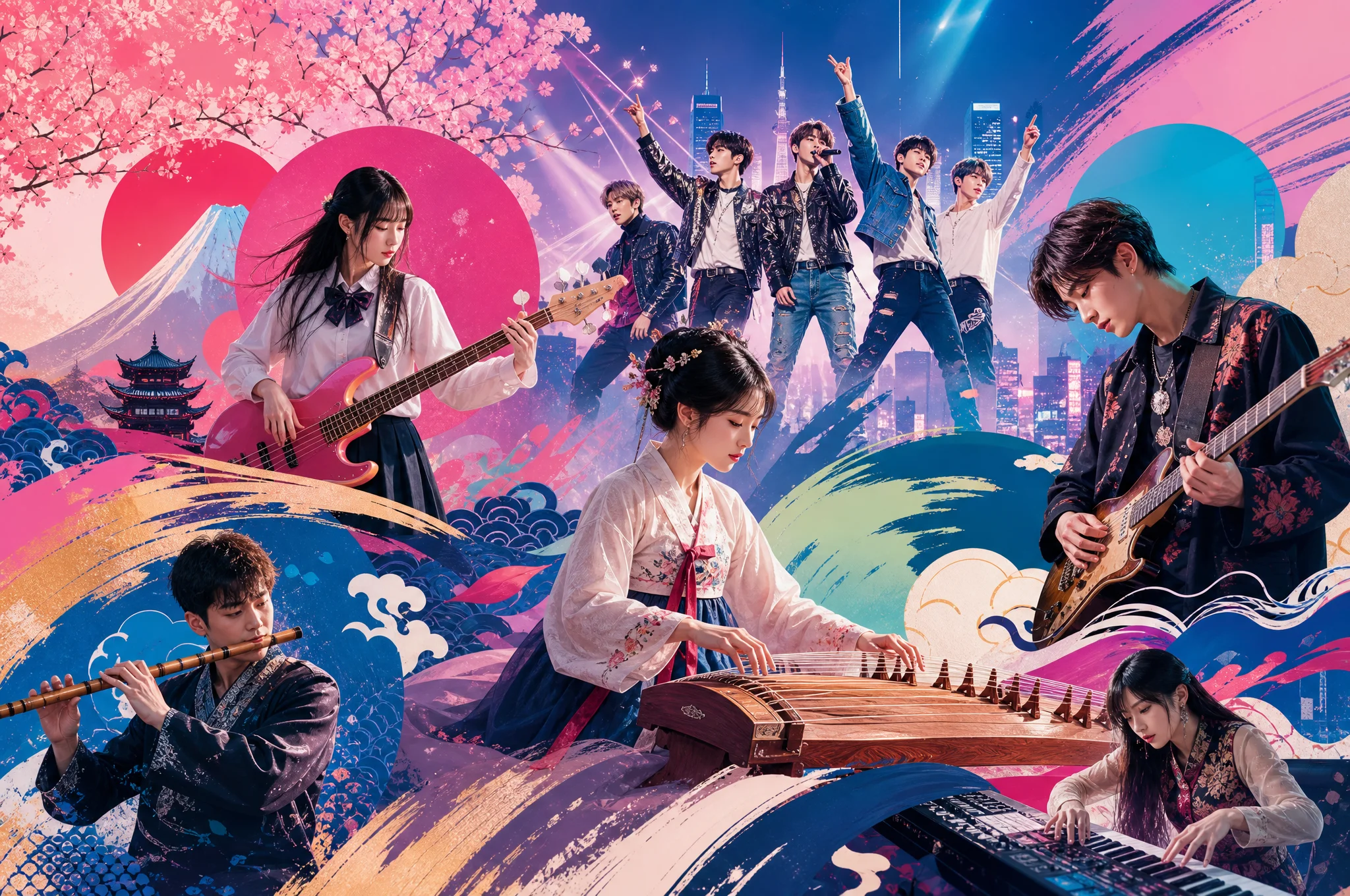
East Asian Music Styles: A Complete Guide to AI Music Creation
Explore East Asian music styles and subgenres, and master AI music creation techniques. Create professional East Asian music with MusicMake.ai.
What Is East Asian Music?
East Asian music encompasses the musical traditions of China, Japan, Korea, Mongolia, and other countries and regions. From Chinese silk-and-bamboo music to Japanese Gagaku, from Korean court music to Mongolian throat singing, East Asian music is characterized by refined melodies, unique scale systems, and deep cultural significance.
The essence of East Asian music lies in mood and negative space. Unlike Western music's pursuit of rich harmony and full sound, East Asian music emphasizes the beauty of melodic lines, tonal variation, and the art of creating meaning through silence. This aesthetic philosophy is deeply rooted in Chinese Daoist philosophy, Japanese Zen Buddhism, and Korean Confucian traditions.
For AI music creation, East Asian music is an incredibly valuable domain. Understanding unique scale systems such as the pentatonic scale and the miyako-bushi scale, as well as the timbres of distinctive instruments like the guzheng, erhu, shakuhachi, and shamisen, is key to generating high-quality East Asian music.
Core Characteristics of East Asian Music
- Pentatonic Scale Foundation: Chinese and Korean traditional music is based on the pentatonic scale (do-re-mi-sol-la)
- Miyako-bushi Scale: Japanese music uses the distinctive miyako-bushi scale, which includes semitones
- Melody-Driven: Emphasis on the beauty of melodic lines rather than harmonic richness
- Ornamentation Techniques: Rich decorative techniques such as slides, vibrato, and pressed tones
- Negative Space and Silence: Valuing silence and spatial awareness within the music
- Distinctive Instruments: Guzheng, erhu, pipa, shakuhachi, shamisen, gayageum, and more
- Poetry-Music Tradition: Music is closely linked with poetry, calligraphy, and other art forms
- Ceremonial Function: Much traditional music is associated with rituals, offerings, and meditation
History of East Asian Music
The history of East Asian music dates back thousands of years. China's Zhou Dynasty (11th–3rd century BCE) established a comprehensive ritual music system, where music was considered an essential tool for governing the nation. The guqin—one of China's oldest stringed instruments—has been passed down among scholars and literati for millennia, becoming a symbol of Chinese culture.
Japanese music was heavily influenced by China but developed its own unique aesthetics. Gagaku was introduced from Tang Dynasty China and evolved into Japanese court music; the musical traditions of Noh and Kabuki theater are even more distinctly Japanese. The shakuhachi—Japan's bamboo flute—is renowned worldwide for its deep timbre and Zen connotations.
Korean music (gugak) also has a long tradition. Court music (jeongak) is refined and elegant, while folk music (minsogak) is more vibrant. The gayageum—Korea's traditional stringed instrument—is a symbol of Korean music. Mongolian throat singing—the technique of producing two or more pitches simultaneously—is a unique treasure of human vocal art.
Creating East Asian Music with MusicMake.ai
MusicMake.ai offers multiple ways to create East Asian music:
Method 1: Using the AI Music Generator
Visit the Generate page and enter a description of the East Asian style you want. The built-in AI Style Generator can help you turn vague ideas into precise East Asian style descriptions.
Method 2: Using Music Agent
Tell Music Agent the East Asian style you want, for example:
- "Create a Chinese guzheng piece using the pentatonic scale, with a serene and evocative mood"
- "Compose a Japanese shakuhachi piece, Zen-inspired, ethereal and meditative"
- "Make a piece in the style of Korean court music, using the gayageum"
Method 3: Using AI Style Generator
AI Style Generator helps you explore various East Asian music subgenres, automatically generating style descriptions that include details about scales, instruments, and aesthetics.
East Asian Music Subgenres
| Subgenre | Region | Characteristics | Representative Artists/Works |
|---|---|---|---|
| Chinese Classical | China | Silk-and-bamboo instruments, pentatonic scale | "High Mountains and Flowing Water," "Moon Reflected in the Second Spring" |
| Chinese Folk Music | China | Regional characteristics, ethnic instruments | Liu Tianhua, Hua Yanjun |
| Chinese Pop (C-Pop) | China | Modern pop fused with Chinese elements | Jay Chou, Xu Song |
| Japanese Gagaku | Japan | Court music, gagaku ensemble | Traditional Gagaku |
| Noh | Japan | Dramatic music, flute, small drum | Traditional Noh |
| Japanese Enka | Japan | Japanese ballads, emotional expression | Sayuri Ishikawa, Teresa Teng |
| J-Pop | Japan | Japanese pop music | Hikaru Utada, Kenshi Yonezu |
| Anime Music | Japan | Animation and game soundtracks | Joe Hisaishi, Yuki Kajiura |
| Korean Gugak | Korea | Court music, sanjo | Hwang Byung-ki, An Mae-sun |
| K-Pop | Korea | Korean pop music | BTS, BLACKPINK |
| Mongolian Throat Singing | Mongolia | Throat singing, morin khuur | Huun-Huur-Tu |
| Mongolian Long Song | Mongolia | Extended melodies, steppe style | Traditional Mongolian Long Song |
| Taiwanese Hokkien Ballads | Taiwan | Hokkien language, Taiwanese character | Teresa Teng, Jiang Hui |
| Hong Kong Cantopop | Hong Kong | Cantonese, Cantonese opera influence | Leslie Cheung, Danny Chan |
East Asian Music Prompt Examples
Here are reference prompts for generating East Asian music with MusicMake.ai:
Chinese Guzheng Piece:
"A Chinese guzheng piece, pentatonic scale, evoking the imagery of high mountains and flowing water, elegant and refined, suitable for tea ceremonies and meditation, traditional silk-and-bamboo music style."
Japanese Shakuhachi:
"A Japanese shakuhachi solo, Zen-inspired style, ethereal and profound, miyako-bushi scale, with ample negative space and breath-like quality, suitable for meditation and relaxation."
Korean Court Music:
"A Korean court music piece, gayageum and daegeum ensemble, refined and elegant, traditional jeongak style, evoking the atmosphere of the Joseon Dynasty court."
Mongolian Throat Singing:
"A Mongolian throat singing piece, overtone singing technique, morin khuur accompaniment, steppe style, vast and profound, in the style of Huun-Huur-Tu."
MusicMake.ai Is Free from Commercial Risk
East Asian music created with MusicMake.ai is free from commercial risk. All AI-generated music can be used for personal projects, commercial purposes, video soundtracks, game audio, and more—without worrying about copyright disputes. This allows you to freely use generated East Asian music in various creative and commercial projects.
Recommended MusicMake.ai Features
| Feature | Use Case | Link |
|---|---|---|
| AI Music Generator | Quickly generate East Asian music clips | Generate |
| Music Agent | Conversational creation with precise style control | Chat |
| AI Style Generator | Explore East Asian subgenre combinations | Style Generator |
| AI Prompt Enhancer | Expand simple ideas into full descriptions | Generate |
East Asian Music Fusion with Other Genres
The unique timbres of East Asian music make it a creative treasure trove for cross-genre fusion:
- East Asian + Pop: C-Pop, J-Pop, and K-Pop blend East Asian traditions with modern pop
- East Asian + Electronic: Electronic East Asian music has gone viral on TikTok worldwide
- East Asian + Jazz: Fusion jazz incorporates East Asian scales and traditional instruments
- East Asian + Rock: Japanese visual kei and Chinese rock incorporate traditional elements
- East Asian + Hip-Hop: East Asian hip-hop fuses traditional instruments with modern beats
In MusicMake.ai, you can explore these fusion styles by combining descriptions, such as "Chinese style + R&B" or "Japanese traditional + electronic beats."
Best Practices for East Asian Music AI Creation
-
Specify Country and Tradition: East Asian musical styles vary significantly between countries. Clearly state whether you want Chinese, Japanese, Korean, or Mongolian style, and whether it should be traditional or a modern fusion.
-
Indicate Scale Type: The pentatonic scale is the foundation of Chinese and Korean music, while the miyako-bushi scale characterizes Japanese music. Specifying the scale type in your prompt yields more accurate melodies.
-
Describe Instrument Timbres: Instruments like the guzheng, erhu, pipa, shakuhachi, shamisen, and gayageum have highly distinctive timbres. Specify instrument names in your prompt.
-
Consider Aesthetic Principles: The Chinese concept of "yijing" (mood), the Japanese concept of "ma" (negative space), and the Korean concept of "heung" (excitement)—understanding these aesthetic concepts helps generate more authentic works.
-
Incorporate Modern Elements: Modern East Asian pop music (such as C-Pop, J-Pop, K-Pop) incorporates extensive Western production techniques. Specify the balance between traditional and modern in your prompt.
FAQ
Can AI generate traditional music from different East Asian countries?
Yes, MusicMake.ai has been trained on extensive East Asian music and can generate traditional music styles from China, Japan, Korea, Mongolia, and other countries. Clearly specifying the country and tradition type in your prompt will yield more accurate results.
What is the difference between the pentatonic scale and the miyako-bushi scale?
The pentatonic scale (do-re-mi-sol-la) has no semitones and sounds bright and harmonious; the miyako-bushi scale (which includes semitones) carries a distinctive Japanese sense of melancholy. Both are important foundations of East Asian music, but they evoke very different emotional colors.
Which East Asian traditional instruments does MusicMake.ai support?
MusicMake.ai can simulate the timbres of various East Asian traditional instruments, including the guzheng, erhu, pipa, dizi, shakuhachi, shamisen, gayageum, morin khuur, and more. Specifying instrument names in your prompt will yield more accurate results.