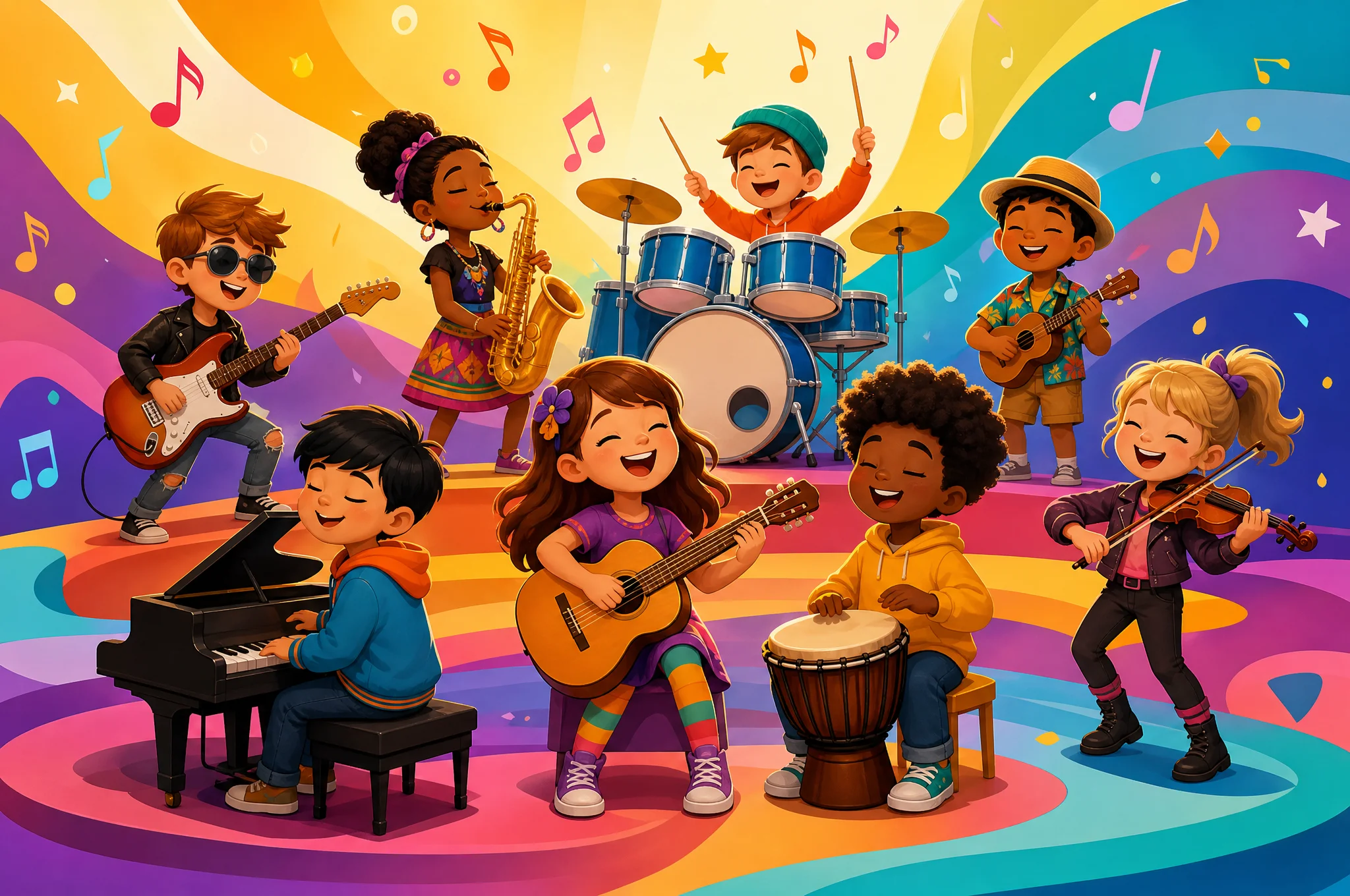
Children's Music: A Complete Guide to AI Music Creation
Explore children's music styles and subgenres, and master AI music creation techniques. Create professional children's music with MusicMake.ai.
What Is Children's Music?
Children's Music is a genre specifically created and performed for children, characterized by simple, memorable melodies, educational lyrics, and a lively, cheerful atmosphere. It is far more than just "songs for little kids" — it is a carefully crafted genre that strikes a balance between fun and education.
Great children's music shares several key traits: catchy melodies, upbeat but not overly intense rhythms, and positive, imaginative lyrics. Instrumentation typically features bright, gentle sounds such as xylophones, bells, harmonicas, and ukuleles, creating a warm and safe listening environment.
In AI music creation, children's music is a genre ripe for creativity. Its relatively straightforward structure and well-defined emotional tone make it an ideal match for AI to understand and generate music that resonates with young listeners.
Whether you need background music for kindergarten lessons, children's video content, or educational apps, MusicMake.ai helps you quickly produce high-quality children's music. From upbeat nursery rhymes to gentle lullabies, AI captures the essence of children's music with precision.
Core Characteristics
- Simple, memorable melodies: Moderate vocal range with clear melodic lines, easy for children to sing along
- Lively, upbeat rhythms: Typically medium to fast tempos with a strong sense of groove
- Imaginative lyrics: Themes centered on animals, nature, adventure, and other topics children love
- Bright, warm timbres: Xylophones, bells, hand drums, and other percussion with pleasant tones, avoiding harsh sounds
- High repetition: Repeated choruses and sections help children memorize and participate
- Educational elements: Numbers, letters, colors, manners, and other learning content woven in naturally
- Interactivity: Clapping, stomping, sing-along prompts, and other participatory moments
- Sense of safety: An overall warm, positive atmosphere free from negative emotional expression
- Clear structure: Classic forms like AABA or ABAB with distinct sections, making it easy for children to follow
- Flexible tempo: Adjusted by purpose — morning exercise music is faster (120-140 BPM), bedtime music is slower (60-80 BPM)
- Adapted vocal range: Generally kept within one to one-and-a-half octaves, suitable for children's still-developing vocal cords
- Direct emotional expression: Joy, curiosity, and surprise are conveyed through melody and rhythm without complex emotional layers
- Clean sound layers: Typically no more than 3-4 instruments playing simultaneously, keeping each timbre distinct for young listeners
History
Children's music traces its roots to ancient lullabies and folk songs. Before the printing press, orally transmitted nursery rhymes were already a vital part of children's culture. The 18th-century Mother Goose collection remains one of the earliest compilations of children's rhymes and is still widely sung today.
In the mid-20th century, the rise of the recording industry turned children's music into a professional field. Artists like Pete Seeger and Raffi in the United States, and classics like "Let Us Row Our Oars" in China, became enduring favorites. Television brought shows like Sesame Street, elevating children's music to new heights.
Contemporary children's music is increasingly diverse. From global phenomena like Baby Shark to educational music blending multiple cultural influences, the genre continues to push beyond its traditional boundaries. AI technology now makes it possible to tailor music for different age groups and educational needs.
In China, children's music is also evolving. From traditional nursery rhymes to modern children's pop, creators are exploring ways to integrate Chinese cultural heritage into children's music.
The educational value of children's music is well documented. Cognitive research shows that musical activities effectively promote language skills, spatial reasoning, and mathematical thinking in children. Singing along to songs helps children learn vocabulary and grammar while unconsciously strengthening memory and attention. Rhythm training further supports fine motor skill development, and many educational institutions have woven music into daily teaching.
From a social-emotional perspective, children's music plays an equally vital role. Group musical activities like choir singing and ensemble playing help children learn cooperation and sharing, while themes of friendship, courage, and kindness in lyrics subtly shape their values. Studies show that children regularly exposed to music demonstrate better emotional regulation and empathy — music becomes a bridge connecting their inner world to the outside society.
Children's Music in the Digital Age
The proliferation of the internet and smart devices has fundamentally changed how children access music. Streaming platforms put vast libraries of children's music at their fingertips, and children's channels on YouTube boast billions of views. Short-video platforms have spawned viral children's songs, with global hits like Baby Shark and PPAP demonstrating the enormous influence of children's music in the digital era.
AI technology is bringing revolutionary changes to children's music creation. Platforms like MusicMake.ai empower parents and educators with no musical background to easily create personalized children's music. From custom birthday songs for kids to soundtracks tailored to specific teaching topics, AI has dramatically lowered the barrier to children's music creation while giving every child their own unique music.
The rise of smart speakers and voice assistants has also introduced new interactive forms. Children can request songs by voice, participate in music games, and even have musical conversations with AI. This immersive music experience is redefining the relationship between children and music — from passive listening to active participation and creation.
However, the digital age also brings new challenges. Screen time management, content quality filtering, and hearing health protection all require attention from parents and educators. Choosing high-quality, educationally valuable children's music and managing usage time wisely ensures that digital-age children's music truly serves children's healthy development.
Creating Children's Music with MusicMake.ai
Using AI Music Generator
Visit the Generate page and enter a description of the children's music style you want. For example:
- "Upbeat children's song with xylophone and ukulele accompaniment, suitable for ages 3-6"
- "Gentle lullaby with piano and music box sounds, soothing for sleep"
The built-in AI Style Generator can help turn vague ideas into precise children's music style descriptions.
Using Music Agent
Tell Music Agent what kind of children's music you want. For example:
- "Create a children's song about little animals with a cheerful rhythm"
- "Compose a bedtime piece using music box sounds"
- "Generate music suitable for kindergarten morning exercises"
Using AI Prompt Enhancer
In Simple mode, AI Prompt Enhancer can expand a single sentence into a complete children's music description, automatically adding details about age suitability, instrumentation, and emotional atmosphere.
Subgenres
| Subgenre | Description |
|---|---|
| Classic Nursery Rhymes | Traditional nursery rhymes and children's songs |
| Educational Songs | Songs incorporating numbers, letters, and other learning content |
| Lullabies | Gentle, soothing bedtime music |
| Kids Pop | Pop-style children's music |
| Kids Rock | Rock music adapted for children |
| Kids Hip-Hop | Children's rap with hip-hop beats |
| Kids Electronic | Electronic-style children's music |
| Animation Themes | Theme music from animated shows and cartoons |
| Children's Folk | Folk-style children's songs |
| Children's Classical | Simplified classical music pieces |
| Interactive Songs | Music with actions and response prompts |
| World Children's | Children's music from diverse cultural backgrounds |
| Children's Gospel | Gospel music adapted for children |
| Kids Latin | Children's music with Latin rhythms |
| Kids Reggae | Reggae-style relaxing children's music |
| Musical Theater | Songs in the style of children's musical theater |
| Kids Blues | Simplified blues for children |
| Children's ASMR | Gentle ASMR-style children's audio |
Best Practices
1. Match the Target Age Group
Children of different ages have different levels of musical comprehension. Children under 3 respond well to simple lullabies and short, upbeat tunes; ages 3-6 can enjoy songs with simple lyrics; ages 6 and up can handle more complex musical styles.
2. Choose Timbres Carefully
Avoid overly sharp or harsh sounds. Xylophones, bells, hand drums, ukuleles, and similar instruments produce bright yet gentle tones that are ideal for children's music. These instruments capture children's attention without harming their hearing.
3. Keep It Simple but Not Monotonous
Children's music should have a clear, simple structure, but you can maintain interest by varying instruments and adding sound effects. Use the AI Style Generator to explore different instrument combinations that keep the music both structured and engaging.
4. Incorporate Educational Elements
Weave numbers, letters, colors, nature facts, and other educational content naturally into lyrics and music, letting children learn through play. Educational value is what sets children's music apart from other genres.
5. No Commercial Risk
Children's music generated with MusicMake.ai carries no commercial risk. You can confidently use it for children's education, video content, or commercial projects. All generated music comes with full commercial licensing.
6. Embrace Cultural Diversity
In today's globalized world, incorporating musical elements from different cultures broadens children's horizons. African drum patterns, Latin rhythms, Eastern pentatonic scales, and other influences can add distinctive color to children's music. MusicMake.ai supports mixing and matching multiple cultural styles, helping you create children's music that combines local character with a global perspective.
7. Protect Hearing Safety
Children's auditory systems are more sensitive and fragile than adults'. When creating and playing children's music, avoid overly sharp high-frequency sounds and excessive volume. Keep playback volume below 60 decibels and limit continuous listening sessions to 30 minutes or less to protect children's hearing health.
FAQ
How can I make AI-generated children's music more appealing to kids?
Use specific age descriptions (e.g., "suitable for 3-year-old toddlers"), bright instrumentation (xylophone, bells), and lively rhythms. Incorporate themes children love, such as animals and nature. Repetitive melodies and simple rhythmic patterns are easier for children to accept and remember.
Can MusicMake.ai generate nursery rhymes in different languages?
Yes. MusicMake.ai supports multi-language music generation. You can specify lyrics in Chinese, English, Japanese, and other languages, and the AI will adjust the musical style based on the target language's cultural characteristics. Whether it's a Chinese nursery rhyme or an English nursery song, the AI produces work that fits the linguistic and cultural context.
What scenarios is children's music suitable for?
Children's music is ideal for kindergarten lessons, children's video content, family education apps, playgrounds, parent-child activities, and more. Music generated with MusicMake.ai carries no commercial risk and can be used freely. Whether for classroom teaching or family entertainment, children's music creates a joyful learning environment for kids.
Is AI-generated children's music safe for long-term playback?
AI-generated children's music is essentially no different from traditionally produced children's music in terms of audio quality and content safety. The key is choosing age-appropriate, positive music. We recommend that alongside AI music, parents also expose children to live performances and interactive musical activities to maintain a diverse musical experience.
How do I choose the right music tempo for different age groups?
Generally, infants (0-1 year) suit slow lullabies at 60-80 BPM; toddlers (1-3 years) enjoy medium-tempo songs at 80-100 BPM; preschoolers (3-6 years) respond well to lively songs at 100-120 BPM; and school-age children (6+) can handle faster music at 120-140 BPM. MusicMake.ai lets you specify the target age group during generation, and the AI automatically matches the appropriate tempo and style.