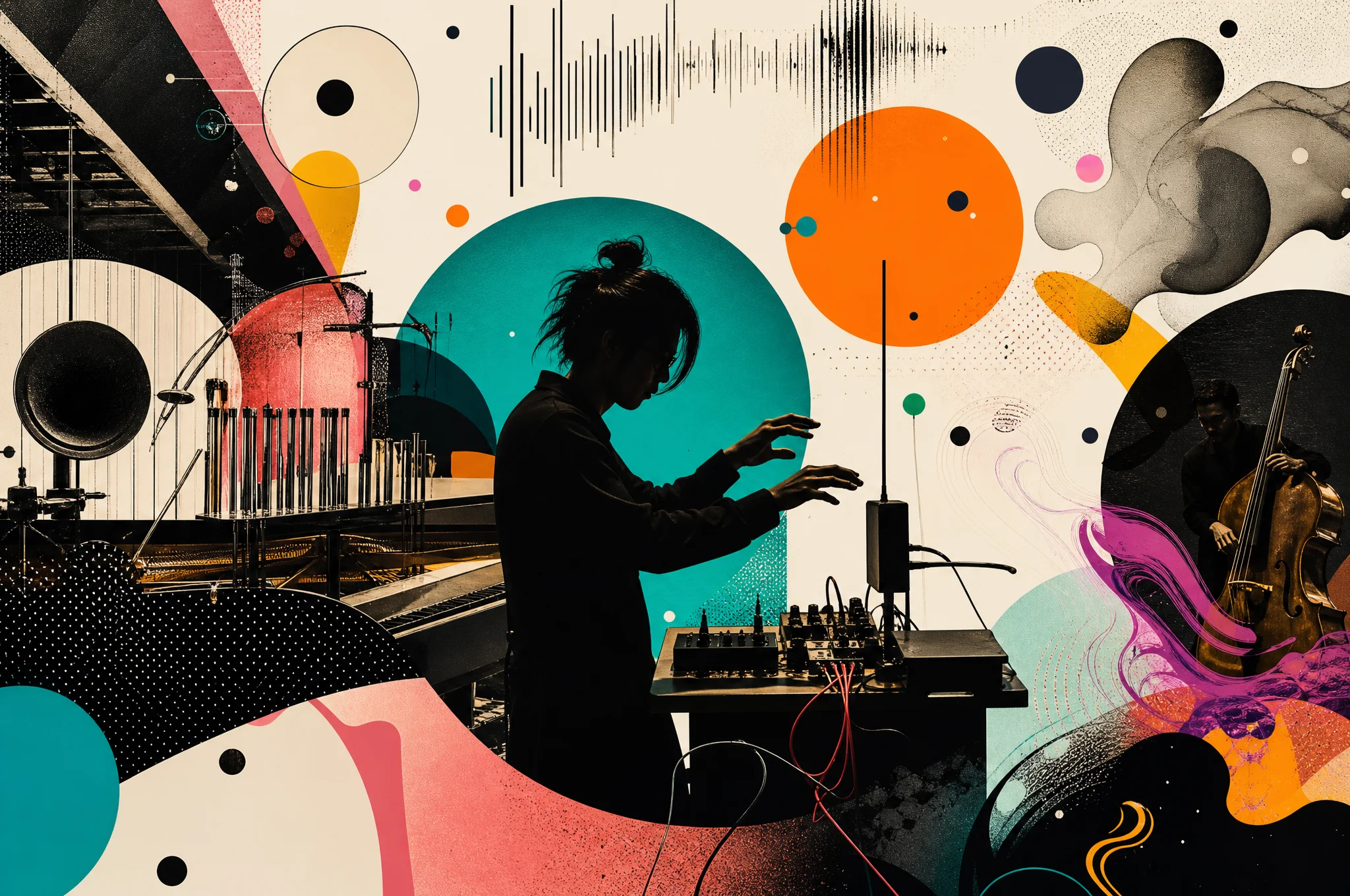
Experimental Music Genre: A Complete Guide to AI Music Creation
Explore experimental music genres and subgenres, and master AI music creation techniques. Create professional experimental music with MusicMake.ai.
What Is Experimental Music?
Experimental Music is a form of music centered on exploring the possibilities of sound. It does not follow traditional musical structures and rules, but instead challenges listeners' preconceptions of "music" through innovative techniques, unconventional sound sources, and bold sound processing.
The boundaries of experimental music are fluid — it can be John Cage's silent composition 4'33", Pierre Schaeffer's Musique Concrète, or algorithmically generated soundscapes by contemporary artists. The core spirit of this music lies in refusing to be constrained by existing musical language and continuously exploring new possibilities of sonic expression.
In AI music creation, experimental music is one of the most innovative fields. AI can generate timbral combinations and structures that traditional music theory could scarcely imagine, providing entirely new tools and perspectives for experimental music composition.
Whether you are a sound artist, independent musician, or art school student, MusicMake.ai helps you explore the boundaries of sound and create unprecedented musical works. From Minimalism to Noise Music, from Sound Art to algorithmic composition, AI can be your powerful creative assistant.
Core Characteristics
- Breaking Conventional Structures: Rejecting traditional song structures (verse-chorus) in favor of nonlinear, aleatoric, or unpredictable forms
- Unconventional Sound Sources: Using everyday objects, ambient sounds, electronic noise, and other non-traditional sources, incorporating the entire sonic environment into the creative palette
- Sound Exploration: Focusing on the exploration of timbre, texture, and spatial perception rather than melody and harmony, pursuing the physical properties and sensory impact of sound itself
- Concept-Driven: Often revolving around an artistic concept or sonic philosophy, with meaning that transcends the auditory experience
- Technical Experimentation: Employing innovative recording, processing, and performance techniques such as feedback systems, self-built instruments, and signal processing algorithms
- Cross-Media Integration: Frequently combining with visual art, installation, performance, dance, and film to create multi-sensory immersive experiences
- Challenging Listening Habits: Aiming to disrupt listeners' expectations, create new auditory experiences, and redefine the boundaries of "music"
- Improvisation and Chance: Extensively using improvisation and aleatoric elements, making uncertainty a core creative methodology
- Deconstruction and Reassembly: Disassembling familiar sonic elements and recombining them to create entirely new contexts and meanings
- Temporal Perception Manipulation: Altering listeners' perception of time through techniques such as stretching, compression, and looping
- Challenging Listening Modes: Requiring listeners to abandon passive listening and adopt an active, open mindset for perceiving sound
- Material and Process Over Product: Focusing on the materiality of sound and its generative process rather than the final "finished" product
History
The origins of experimental music can be traced back to the early 20th-century Futurist movement, when Luigi Russolo proposed the concept of "The Art of Noise," arguing that industrial noise should also be considered musical material. In 1913, he built the Intonarumori (noise machines), pioneering Noise Music.
In the 1950s, John Cage became a central figure in experimental music. His aleatoric music and silent composition 4'33" fundamentally transformed how people defined music. During the same period, Pierre Schaeffer developed Musique Concrète in France, using recording technology as a creative tool. Karlheinz Stockhausen advanced the development of electronic music in Germany.
From the 1960s to the 1970s, the influence of experimental music began to permeate mainstream music. Psychedelic experiments in rock, the exploration of electronic devices in progressive rock, and the rise of free improvisation in jazz can all be traced back to experimental music's inspiration. Brian Eno introduced the concept of ambient music into pop production, further blurring the boundary between experimental and commercial music. During this period, experimental music was no longer the exclusive domain of academia but became a catalyst for innovation across the entire musical culture.
From the 1980s to the 1990s, the proliferation of digital technology brought entirely new possibilities to experimental music. Samplers, digital audio workstations, and the internet made sound collection, processing, and distribution far more accessible. Japanese noise culture (such as Merzbow) rose in Asia, and electronic experimental music flourished in Europe. The influence of experimental music expanded further into film scoring, installation art, and multimedia performance, becoming an indispensable component of contemporary artistic creation.
Contemporary experimental music presents an increasingly diverse landscape. From Minimalism to Noise Music, from Sound Art to algorithmic composition, the boundaries of experimental music continue to expand. Advances in digital technology have made sound processing and generation more accessible than ever, and the introduction of AI has brought revolutionary possibilities to the field.
Experimental Music in the Digital Age
Digital technology has fundamentally transformed how experimental music is created. Sound processing that once required expensive equipment and professional studios can now be accomplished on a laptop. Open-source software and free audio tools have lowered the barrier to entry, enabling more people to participate in the exploration of experimental music.
The internet has also provided entirely new platforms for the distribution and collaboration of experimental music. Platforms like SoundCloud and Bandcamp allow independent experimental musicians to reach a global audience directly, without relying on traditional record label channels. Online communities and forums facilitate exchange and collaboration among artists, making cross-border remote collaboration commonplace.
The rise of AI technology has added a new dimension to experimental music. Machine learning algorithms can analyze vast amounts of musical data, discover sound patterns that are difficult for humans to perceive, and generate entirely new timbres and structures. Generative music systems can create ever-evolving dynamic soundscapes, blurring the line between composition and improvisation. MusicMake.ai is a prime example of this trend — it enables anyone to explore the infinite possibilities of experimental music through simple text descriptions.
Creating Experimental Music with MusicMake.ai
Using the AI Music Generator
Visit the Generate page and enter a description of your desired experimental music style. For example:
- "Abstract soundscapes with irregular rhythms and unconventional timbres"
- "Minimalist electronic experimentation with continuous timbral shifts and spatial depth"
The built-in AI Style Generator can help you transform vague ideas into precise experimental music style descriptions.
Using the Music Agent
Tell the Music Agent about the experimental style you want. For example:
- "Create an experimental piece using noise and industrial sound effects"
- "Generate a minimalist timbral experiment"
- "Make an abstract electronic piece incorporating ambient sounds"
Using the AI Prompt Enhancer
In Simple mode, the AI Prompt Enhancer can expand a single sentence into a complete experimental music description, automatically adding details about sound processing, structural forms, spatial depth, and more.
Subgenres
| Subgenre | Description |
|---|---|
| Musique Concrète | Using recorded real-world sounds as source material |
| Noise Music | Using noise as the primary sonic material |
| Minimalism | Repetitive simple patterns with gradual changes |
| Sound Art | Art creation using sound as the medium |
| Aleatoric Music | Incorporating random and indeterminate elements |
| Electroacoustic | Fusion of electronic and acoustic sounds |
| Industrial | Mechanical, metallic sound aesthetics |
| Ambient Experimental | Space- and atmosphere-oriented experimentation |
| Algorithmic Composition | Generating music through mathematical or programmatic logic |
| Microtonal | Using pitches between traditional semitones |
| Free Improvisation | Performance without predetermined structures |
| Sound Collage | Assembling and combining different sound fragments |
| Power Electronics | Extreme electronic noise and vocal processing |
| Tape Music | Experimental music using tape recording techniques |
| Live Electronics | Real-time processed electronic music in live settings |
| Spectral Music | Composition based on sound spectrum analysis |
| Interactive Music | Music that interacts with listeners or the environment |
| Generative Music | Music automatically generated by rule-based systems |
Best Practices
1. Don't Be Afraid to Break the Rules
The essence of experimental music is pushing boundaries. When generating with AI, try unconventional descriptors such as "dissonant," "fractured," "distorted," or "suspended" to produce unique timbres and structures.
2. Embrace AI's "Happy Accidents"
AI-generated experimental music may produce unexpected results. These "accidents" are often the most interesting parts of experimental music — learning to appreciate and leverage them can lead to surprisingly delightful works.
3. Explore the Boundaries of Sound
Use the AI Style Generator to try extreme style combinations, such as "Classical + Noise" or "Minimalist + Industrial." The value of experimental music lies in exploring uncharted sonic territories and challenging traditional musical concepts.
4. Focus on Space and Texture
Experimental music often emphasizes spatial depth and sonic texture rather than traditional melody and harmony. In your descriptions, highlight keywords like "spacious," "reverberant," and "textural" to guide the AI toward more experimental output.
5. No Commercial Risk
Experimental music generated with MusicMake.ai carries no commercial risk. You can confidently use it in art projects, exhibitions, film scores, or personal creations. All generated music comes with full commercial licensing.
6. Iteration and Variation
Experimental music creation is often an iterative process. After generating a base piece, you can repeatedly adjust your description to explore different interpretations of the same concept. Try fine-tuning the intensity and combination of keywords to observe how the AI produces subtle yet meaningful variations.
7. Blend Tradition with Experimentation
Don't completely oppose experimental music to traditional music. Many outstanding experimental works deconstruct and reassemble within traditional musical frameworks. Try incorporating traditional instruments or musical elements into your descriptions to let the AI create tension between the familiar and the unfamiliar.
FAQ
How do I get AI to generate more "experimental" music?
Use counter-conventional descriptors such as "rule-breaking," "unpredictable," "abstract," or "non-conventional structure." You can also try combining seemingly unrelated stylistic elements, like "classical orchestration + industrial noise." The appeal of experimental music lies in breaking conventions, and AI can help you explore sound combinations that traditional compositional methods would struggle to achieve.
Can MusicMake.ai generate Noise Music?
Yes. MusicMake.ai supports a wide range of experimental styles, including Noise Music. You can describe the sound characteristics you want on the Generate page, and the AI will produce corresponding works. From gentle ambient noise to extreme Power Electronics, AI can accurately capture the sonic aesthetics of experimental music.
What scenarios are suitable for experimental music?
Experimental music is well suited for art exhibitions, film scores, dance performances, installation art, game sound design, avant-garde fashion shows, and more. Music generated with MusicMake.ai carries no commercial risk and can be used freely. Whether for contemporary art projects or independent film creation, experimental music adds a unique artistic quality to any work.
What is the difference between experimental music and avant-garde music?
Avant-garde music typically refers to progressive creations that challenge mainstream musical ideas within a specific historical period, emphasizing artistic innovation and forward-thinking vision. Experimental music focuses more on the exploration of sound itself and the experimental process, not necessarily carrying the intent of being "ahead of its time." The two overlap significantly, but experimental music has a broader scope and includes more process-oriented creation. In MusicMake.ai, you can use similar descriptors to generate both styles.
Can I create experimental music without a musical background?
Absolutely. A key characteristic of experimental music is that it does not rely on traditional music theory or technique. Many renowned experimental musicians are not formally trained — they rely on their sensitivity to sound and spirit of exploration. MusicMake.ai's AI tools further lower the barrier to entry — you only need to describe the sound you envision in words, and the AI can bring it to life. In a sense, a "non-expert" ear may even bring a more unique experimental perspective.